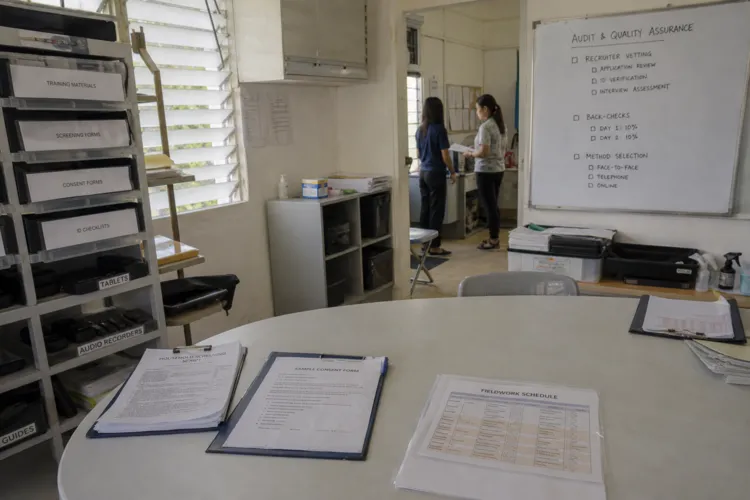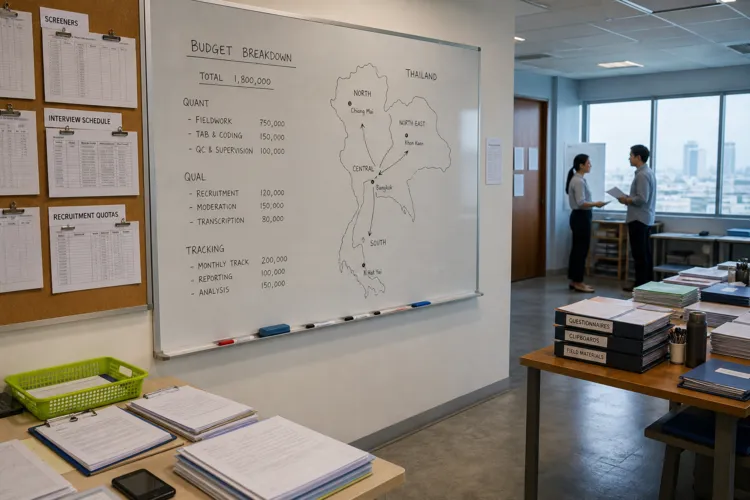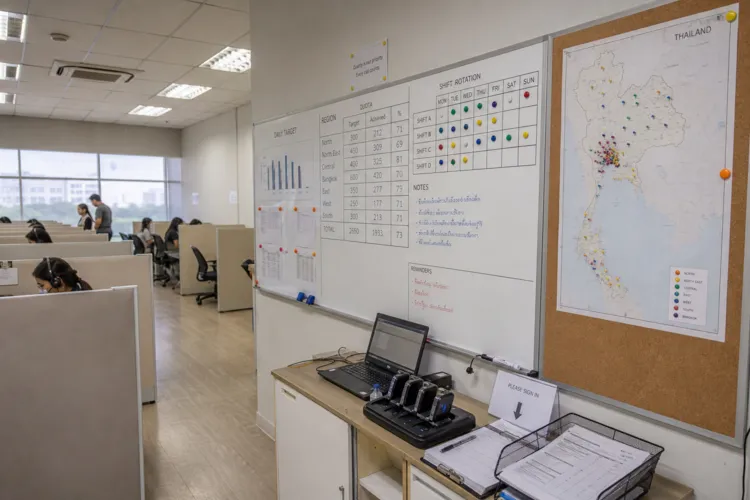
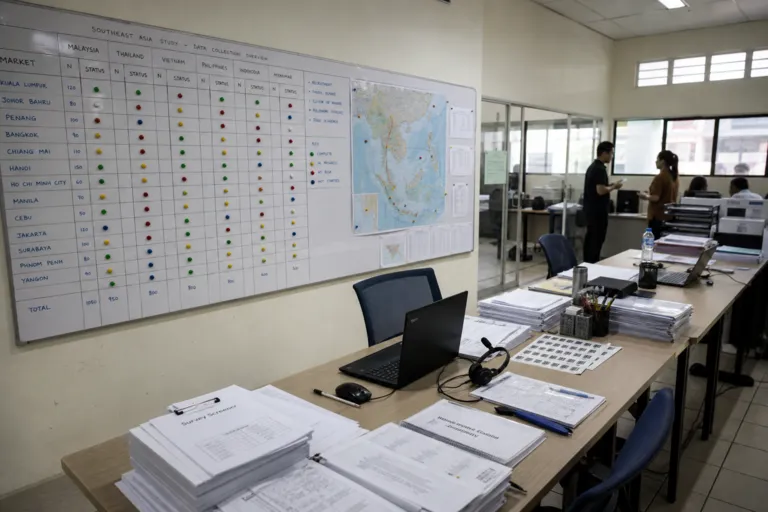
Multi-country market research involves multiple countries as part of a qualitative or quantitative project. Done well, it helps managers uncover patterns, attitudes, similarities, and differences, while also revealing new opportunities. In Southeast Asia, that promise comes with practical constraints. SIS International notes that language is often the primary challenge, and each country can have at least five to hundreds of languages spoken. Indonesia has over 700 languages, and the Philippines has 185 languages spoken, even though English and Filipino are official languages. Secondary research can also be limited, with government transparency not consistently practiced and censorship existing for online content. Plan for these realities from day one, because they shape sampling, questionnaires, timelines, and the strength of cross-country comparisons.
Start by defining which markets truly matter for your decision. SIS International recommends identifying target markets using geographic location, demographics, and psychographic factors such as age, gender, income, education, attitude, and values. Then evaluate economic and political factors that influence viability, including the regulatory landscape and indicators such as tax laws, intellectual property rights, inflation rate, and unemployment rate. In parallel, build a cultural analysis that looks at norms and values, attitudes, beliefs, and social structures so your messaging and measurement reflect local context. If you are building a regional view, treat the research design like an engineering problem: specify what must be consistent across countries, and what must be localized to avoid misleading results.
How to Keep Methods Comparable Across Markets
Comparability usually breaks when each country uses different sizing assumptions and inconsistent sources. A Southeast Asia case study describes fragmented, outdated, or inconsistent secondary sources, and market sizing methodologies that varied widely, reducing comparability. The approach that improved results combined systematic secondary review, data triangulation, and primary research execution across priority markets, including expert interviews, customer surveys, and stakeholder workshops. It also used consistent assumptions and validation checkpoints to build market models, then synthesized findings into actionable insights aligned with strategic use cases. In that engagement, the research reduced time-to-decision by 20–30% and helped prioritize high-potential markets representing 60–70% of projected regional growth, while avoiding misallocation of capital equivalent to 10–15% of planned investments.
Execution details matter in Southeast Asia, especially for fieldwork-heavy studies. SIS International highlights that weather can heavily affect scheduling: between May and October, the region experiences heavy rains and typhoons that can cause flooding and power and telecommunications failures, particularly where infrastructure is poor. Urban traffic congestion also affects timing and reduces the number of home visits and In-Depth Interviews (IDIs) possible per day. Safety concerns can limit late-night interviews, pushing scheduling toward daytime and early evening. Researchers also need to comply with prayer times and religious holidays; in the Philippines and East Timor, Easter and Christmas can close businesses for a week to two weeks before, during, and after the holidays, while in Indonesia, Brunei, and Malaysia, scheduling should consider prayer times and holidays.
Finally, choose an operating model that balances speed with local fidelity. Some teams use platforms to launch one project across multiple countries and analyze results by market or as a combined regional dataset; Standard Insights says it supports over 150 languages, including translation and AI-powered analysis, and offers pricing starting from $3 per respondent. Others rely on partners with on-the-ground coverage; Kadence notes it has offices in 8 countries across Asia and can support fieldwork-heavy multi-market studies. Whichever route you take, build language planning and quality control into the core plan, not as a final step. This is the practical center of multi-country market research in Southeast Asia: consistent measurement, localized execution, and clear rules for what can and cannot be compared.
What does multi-country market research involve in Southeast Asia?
Why is language planning so important for research across the region?
How can teams keep cross-country findings comparable?
What fieldwork constraints commonly disrupt timelines in Southeast Asia?
How should a multi-country market research program in Southeast Asia handle holidays and religion?