
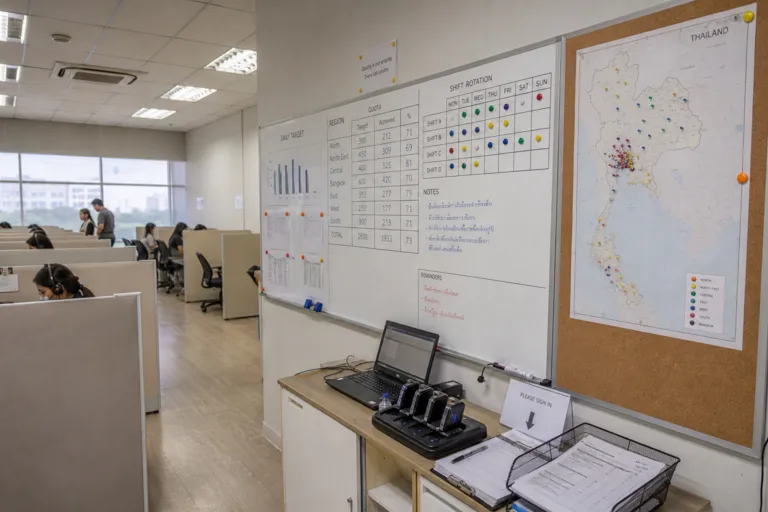
For many teams, an online survey panel Thailand strategy is the fastest way to test concepts, measure awareness, and monitor customer experience. Thailand’s digital foundation supports this: one Thailand market research provider notes around 81.1% of the population were internet users in 2022, with a projection of around 84% by 2026. Another Thailand-focused data collection guide states Thailand has 91.2% internet penetration and among the highest mobile usage rates in Southeast Asia. In practice, that means web-and-mobile surveys (CAWI) can scale quickly, but the sampling plan must be built to match the business footprint beyond the capital.
The main risk is not speed. It is representativeness. Thailand-focused research guidance warns that online panels oversample Bangkok and middle-to-upper income respondents, while rural and lower-income segments are underrepresented. The same guidance adds that Thailand’s provincial markets are approximately 60% of the population, and these consumers can differ by income levels, media consumption, and purchase triggers. When research is scoped only to Bangkok, it can systematically misrepresent the national picture for many categories. So the question becomes practical: how do you keep the efficiency of panel surveys while building credible coverage outside Bangkok?
How to Extend Panel Reach Beyond Bangkok Without Sacrificing Quality
Start with sample design discipline. One Thailand panel provider explains it runs a proprietary double opt-in panel, actively managed for broad coverage of the country’s online population, and uses respondent profiling, screening, and project-specific quotas to match targets. It also states feasibility is checked before fieldwork against audience requirements, incidence rate, and targeting criteria. This is the right structure for provincial expansion: define region quotas upfront, pre-check incidence, and avoid defaulting to whatever the panel supplies most easily. Ongoing “top-up” recruitment is also described as a way to strengthen coverage when certain groups become harder to reach.
Next, protect data quality with clear standards and localized operations. The same provider describes following ESOMAR guidelines, using anti-fraud protections during fieldwork and processing, and supporting projects with local-language teams who understand research conditions in Thailand. This matters because Thai response patterns can affect quality: Thailand survey best-practice guidance notes that negative experiences may be underreported due to kreng jai, and that indirect questioning and anonymous response options can produce more reliable data than direct verbal feedback. Another Thailand data collection guide connects this to acquiescence bias, recommending indirect techniques and reverse-scored scale items to reduce overly positive agreement.
Finally, use mixed methods when you must reach beyond the digital panel frame. Thailand method guidance emphasizes that face-to-face interviewing (CAPI) is used for rural data collection and can improve quality where self-completion literacy is variable, while also allowing interviewers to clarify misunderstood questions and detect disengagement. For brands operating outside Bangkok, that same Thailand data collection guide highlights the need for regional fieldwork teams, local language adaptation, and sampling frames that do not default to urban digital panels. The most reliable programs combine quantitative surveys with locally embedded teams and Thai-language moderation rather than relying only on Bangkok-heavy online panels.
What is the biggest risk when using online panels for Thailand-wide research?
How can an online survey panel in Thailand reach consumers beyond Bangkok more reliably?
Which data quality practices help protect panel survey results in Thailand?
When should you consider face-to-face interviewing (CAPI) instead of only CAWI?