


Brands often start with survey questions about “eco-friendly” preferences, then assume that intention will convert into sales. Yet sustainable consumption research also highlights an intention–behavior gap, where stated intentions often fail to align with real-world choices. That gap matters in Thailand, where consumer behavior research notes that face-saving norms and indirect communication can make stated preferences diverge from actual purchasing decisions. For practical sustainability consumer research Thailand teams, this means the research question is not only “Do you intend to buy green?” but “Under what conditions does intent translate into a purchase?” Closing that gap begins with designing studies that separate attitudes, intention, and the observable decisions consumers actually make.
Thai-focused studies also show why the “intent” side of the equation can look strong. A Frontiers in Sustainability study surveyed Thai Gen Z using an online survey and non-probability sampling, with 1,541 respondents. It reports a significant relationship between sustainable consumption and purchase intention, and highlights the effect of brand image in the decision-making process. Separate work on Thai EV branding argues that credible Green CSR and authentic brand behavior can shape brand perception, which can then link to word-of-mouth and purchase intention. Taken together, these studies support a common finding: consumers can be persuaded and can express intent when brand signals, social influence, and perceived quality line up. But intent is still not the same as repeated purchasing.
Design Research to Measure the Gap, Not Just the Intent
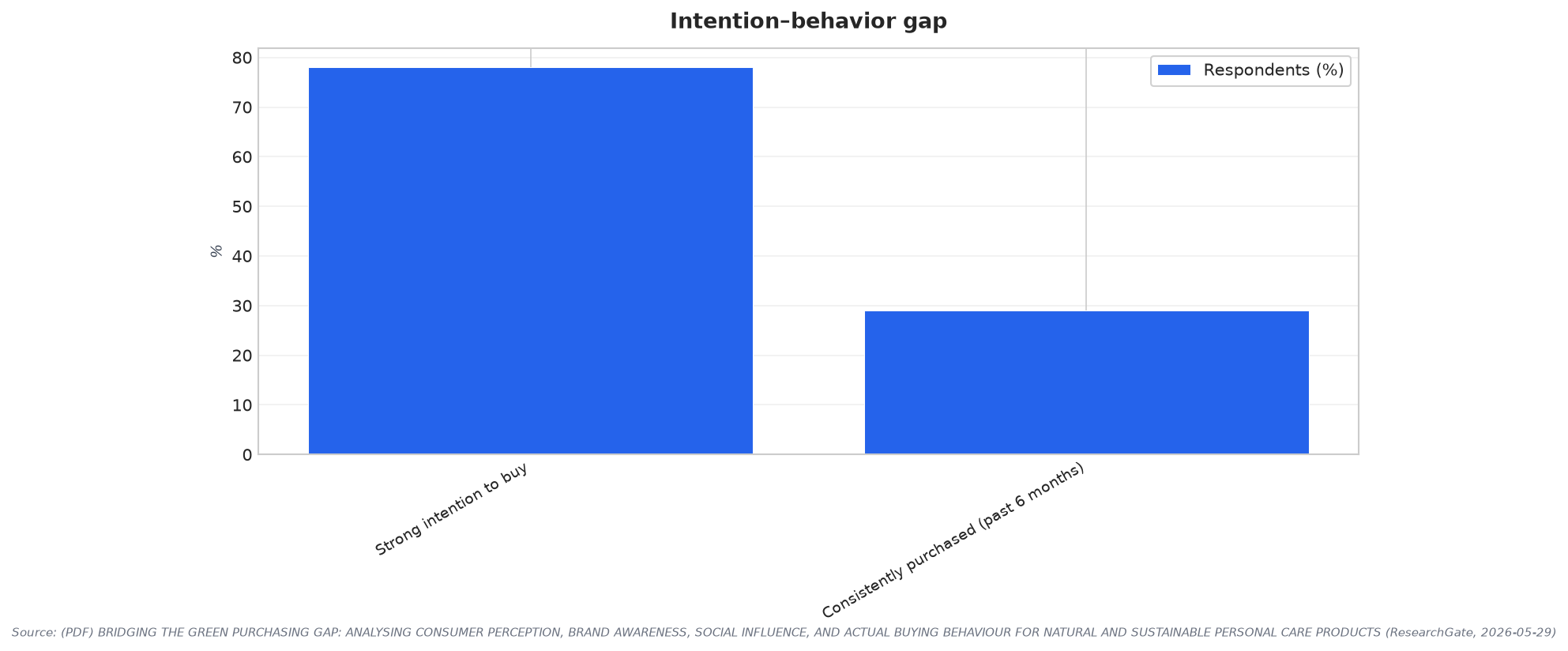
A direct example of the gap comes from a study on natural and sustainable personal care products. It reports a clear green purchasing gap: 78% of respondents expressed a strong intention to buy natural and sustainable personal care products, yet only 29% had consistently purchased such products in the past six months. The same study notes no significant variation in the gap across age or gender groups in that sample, implying that market and awareness factors may override demographic explanations. This is the kind of evidence that should shape study design in Thailand: measure past behavior alongside intention, specify a time window (such as six months), and treat “consistent purchasing” as its own outcome variable rather than assuming a single survey item can stand in for real adoption.
Method choices also affect what you learn. The Thai consumer behavior brief stresses that research in Thailand should be calibrated to indirect communication styles, regional variation, and the gap between what consumers report and what fieldwork observation reveals. That pushes teams beyond generic online surveys and toward mixed approaches: combine stated measures with behavioral checks, and include locally moderated qualitative work to probe what respondents avoid saying directly. For digital environments, measurement can get even more granular. A Thailand-focused paper on green product purchase decisions discusses multimedia advertising exposure and presents the Multimedia Ad Exposure Scale (MMAES), designed to measure short-term effects of online multimedia ad exposure in terms of engagement, psychological reactance, awareness and attitude, and purchase intention. Using such structured exposure measures can help researchers connect specific message encounters to changes in intention, then test whether those changes predict real buying.
To close the stated-versus-actual gap, convert “green intent” research into conversion research. Start with a model that separates drivers of intention (such as brand image, Green CSR credibility, and word-of-mouth) from barriers that block action in everyday shopping. Then instrument the study so it can detect slippage: include recall of purchases over a defined period, ask about consistency rather than one-off trials, and compare segments by familiarity where relevant, as EV research suggests the relationship between brand perception and purchase intention can differ across levels of EV familiarity. Finally, treat Thailand’s communication norms as a research variable, not a footnote. When sustainability studies report strong intentions, the next question should always be: what evidence shows those intentions survive price pressure, promotions, and real retail choices?
What is the intention–behavior gap in green purchasing?
What evidence shows a green purchasing gap in sustainable personal care buying?
Why can stated preferences differ from actual purchases in Thailand?
How can sustainability consumer research in Thailand get closer to real behavior?
What did the Thai Gen Z study measure, and how large was the sample?