For Southeast Asian businesses seeking international growth, Africa represents an increasingly relevant but still underexplored commercial opportunity.
Merchandise trade between ASEAN and Africa reached approximately US$59 billion in 2024, more than eight times its level in 2000. Yet Africa accounts for just 1.7% of ASEAN's merchandise exports, suggesting considerable scope for stronger market connections.
For ASEAN manufacturers, exporters, investors and service providers, the opportunity extends beyond supplying products to new customers. Local production, regional distribution, industrial partnerships and technology transfer are creating alternative pathways for expansion.
ASEAN–Africa: The Next Corridor | How ASEAN and Africa Are Building a New Economic Partnership, and the Opportunities for the Economic Francophonie, developed by the Alliance des Patronats Francophones and the Cambodia Chamber of Commerce in cooperation with Eurogroup Consulting, examines where these opportunities are emerging and how ASEAN businesses could position themselves for growth through 2035.
The whitepaper was launched on 14 November 2026 at the Rencontre des Entrepreneurs Francophones (REF) 2026 in Phnom Penh, the first edition of the annual Francophone business meeting to be held in Southeast Asia. Co-organised by the Alliance des Patronats Francophones and the Cambodia Chamber of Commerce, the event brings Francophone business communities together in Cambodia to turn ASEAN–Africa dialogue into concrete partnerships.
Why Should ASEAN Companies Look More Closely at Africa?
Southeast Asia and Africa offer complementary economic strengths that could support deeper commercial cooperation.
Africa's population reached approximately 1.55 billion in 2025 and is projected to approach 2.5 billion by 2050. Urbanisation and demographic growth are increasing long-term requirements for food, housing, energy, transport, healthcare and industrial products.
ASEAN, meanwhile, combines established manufacturing capabilities with regional supply chains, processing expertise and growing international investment networks.
Existing trade relationships demonstrate commercial potential, but market participation remains concentrated.
Five ASEAN economies, Malaysia, Indonesia, Thailand, Vietnam and Singapore, account for almost all ASEAN–Africa merchandise trade.
For companies considering expansion, the challenge is to move beyond broad continental growth narratives and identify specific markets, customer segments and operating conditions that support commercially viable opportunities.
ASEAN–Africa Trade: Where the Opportunities Are Concentrated
ASEAN exports to Africa reached US$32.7 billion in 2024, compared with US$26.3 billion in African exports to Southeast Asia.
The largest existing opportunities are concentrated in sectors where ASEAN has established manufacturing, processing or distribution strengths.
Food and agriculture account for approximately US$17.8 billion in two-way trade, followed by energy at US$15.0 billion and manufacturing at US$12.7 billion.
Beyond these established sectors, the corridor is expanding into infrastructure, critical minerals, digital financial services and healthcare.
For ASEAN businesses, this creates different commercial entry points. Some opportunities favour competitive exports, while others require local assembly, industrial partnerships, investment or more specialised distribution capabilities.
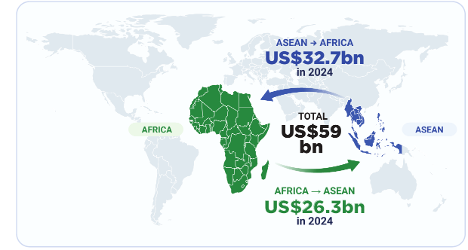
ASEAN–Africa trade by direction in 2024: ASEAN exports to Africa of US$32.7bn and African exports to ASEAN of US$26.3bn, for total two-way trade of US$59bn.
Which African Markets Offer the Strongest Entry Points?
Africa should not be approached as a single homogeneous market.
Differences in purchasing power, regulatory environments, infrastructure, industrial capabilities and regional connectivity create distinct commercial conditions across the continent.
Existing ASEAN–Africa trade is concentrated in several major African economies, and the most suitable entry market depends on the sector and operating model:
- Established trading partners: South Africa, Nigeria, Egypt, Côte d'Ivoire and Morocco.
- Regional gateways: Ports, logistics networks and commercial hubs that connect neighbouring markets.
- For manufacturers: Priority on industrial ecosystems and supply-chain access.
- For consumer businesses: Reliable distribution networks, customer insights and pricing strategies adapted to local demand.
For businesses evaluating long-term expansion, selecting an effective regional gateway can be as important as choosing the initial national market.
From Exporting to Building a Long-Term African Presence
The evolution of ASEAN–Africa trade suggests that international expansion strategies are becoming more sophisticated.
Southeast Asian companies are building a longer-term presence in Africa through different pathways:
- Local production and integrated supply chains: Some companies are moving beyond exporting, particularly where market scale, logistics costs and access to neighbouring countries support investment.
- Services, logistics and partnerships: Others are establishing service operations, logistics platforms and partnerships that connect multiple African markets.
- A growing investment footprint: ASEAN's direct-investment stock in Africa reached an estimated US$30–35 billion at the end of 2024, indicating that business relationships increasingly extend beyond merchandise flows.
The whitepaper identifies five emerging shifts that could influence how companies expand, from local manufacturing to regional platforms and organised business ecosystems.
However, these approaches require careful assessment of local market conditions, potential partners, regulatory requirements and financing risks.
What Could ASEAN–Africa Business Look Like by 2035?
Under the whitepaper's central selective integration scenario, ASEAN–Africa merchandise trade could increase from US$59 billion in 2024 to approximately US$112 billion by 2035, equivalent to around 90% growth.
The projection assumes that targeted industrial partnerships, investment and stronger regional market access support a more integrated economic relationship.
For Southeast Asian businesses, the implications extend beyond increasing export volumes.
Future competitiveness may depend on identifying underserved markets, building the right distribution and production partnerships, and adapting operating models to regional conditions.
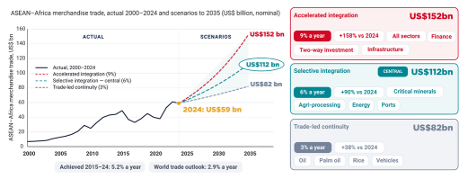
ASEAN–Africa merchandise trade could grow from US$59bn in 2024 to US$112bn by 2035 under the central selective integration scenario, within a range of US$82bn to US$152bn.
The whitepaper provides a research-backed perspective on sector opportunities, investment dynamics, emerging business models and the infrastructure connecting Southeast Asia with African markets.
Download ASEAN–Africa: The Next Corridor to explore the seven priority value pools, regional gateways, company examples and strategic enablers shaping future business opportunities for ASEAN companies.