

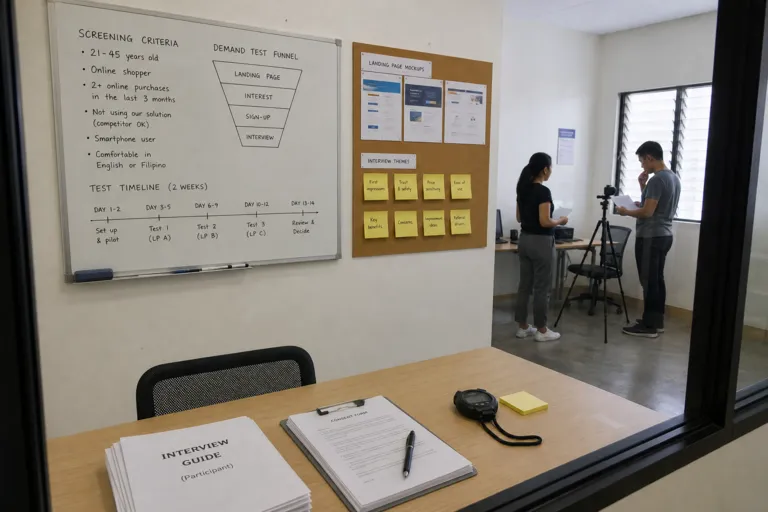
Market research for startups in the Philippines is best treated as validation, not paperwork. The point is to prove real demand exists before you spend months building. Lean market validation is a systematic approach to assessing whether a product or service has market demand before fully launching it, using rapid experimentation, customer feedback, and iterative learning. It is designed to minimize risk by gathering real-time feedback from potential customers and using that data to make decisions. This is also why startup market research is framed as a way to validate or invalidate core assumptions as cheaply and quickly as possible, rather than producing a long report.
The business case is clear even when you look beyond any single country. CB Insights’ analysis of 400+ startup post-mortems is cited as showing that poor product-market fit is the primary underlying cause of failure, and one guide notes that 42% fail because they built something nobody wanted. Another source similarly states that 42% of startups fail due to no market need, and adds that 58% of founders regret skipping dedicated research. Taken together, these numbers underline why founders should prioritize evidence over opinions. Your goal is to reach the moment when an investor asks about validation and you have measurable traction, not guesses.
A Lean Validation Stack: Run 2–3 Methods in Parallel
A practical approach is to combine methods instead of betting everything on one signal. In work with 500+ founders, one framework groups 11 validation methods into three buckets: demand signals (like landing pages, smoke tests, and pre-orders), customer insight (like interviews, surveys, and focus groups), and sizing (like TAM/SAM/SOM and secondary research). It also recommends running 2–3 methods in parallel and moving fast, because skipping validation can mean building what nobody wants. These methods pair well: a landing page can measure sign-ups, while interviews explain why people hesitate, and sizing checks whether the opportunity can support a business.
Keep your discovery tight and structured. One validation guide suggests conducting 30–50 customer discovery interviews to validate pain points, then running a landing page test to measure real interest and conversion. It also proposes pre-sales or pilots to test willingness to pay, and then an MVP prototype tested with 10–20 users for 2–4 weeks. Another source warns that a free waitlist does not prove willingness to pay, noting a gap between interest and purchase, so it helps to test your solution manually before building the full product. When you do surveys, remember they collect quantitative data from larger samples, while interviews and focus groups give deeper qualitative insight.
Use the research to decide whether to pivot, persevere, or stop. The Startup Genome Project is cited as finding that startups need 2–3x longer to validate their market than most founders expect, and that founders overestimate the value of their intellectual property before achieving product-market fit by 255%. The same guidance notes that startups that pivot once or twice based on validated learning achieve 3.6x better user growth and raise 2.5x more funding than those that never pivot or pivot too many times. For additional context on why rigor matters, one source states that 328 million terabytes of data are generated globally each day, which makes extracting actionable insights both critical and challenging. For market research for startups Philippines teams, the win is focus: fewer assumptions, faster tests, and clearer next steps before scaling.
What is lean market validation and why does it matter before scaling?
What are the main categories of methods founders can combine to validate demand?
How many interviews and early users should I test with in a lean validation plan?
What do failure analyses say about skipping market research?
How should market research for startups in the Philippines be approached in practice?