Synthetic data and AI personas are moving from novelty to workflow tool. For Singapore researchers doing synthetic data market research Singapore-style, the practical appeal is simple: faster learning without the friction of recruiting and fieldwork. One 2026 overview frames the promise as instant feedback, zero recruitment costs, and the ability to test concepts before investing in expensive primary research. Another guide argues that traditional survey work is often “waterfall,” where questionnaire design, fielding, cleaning, and analysis can take weeks or months, and it highlights a reference point of $15,000 and six weeks for each iteration. In that context, synthetic personas flip the model: you query a pre-built synthetic population, iterate quickly, and then decide what deserves real-world validation.
The best evidence for synthetic personas is narrow but meaningful. A 2026 synthesis cites Stanford work (Park et al., 2024) showing AI can reproduce the survey responses of a specific person with 83% to 86% of the reliability with which that person repeats themselves after two weeks. The same source reports that agents built from two-hour interviews with 1,052 people reached 83% (interview only), 82% (surveys only), and 86% (combined) of human two-week test-retest reliability, versus 74% for agents prompted purely on demographics. It also describes a purchase-intent result: a Semantic Similarity Rating method achieved 90% of the human test-retest reliability ceiling across 57 product surveys. These figures are not a guarantee of “truth,” but they do suggest a role for early concept, copy, and campaign feedback when the system is well grounded.
Where Synthetic Personas Break Down: Volatility, Bias, and False Confidence
The same body of research warns that using synthetic respondents as a substitute for representative surveys can fail in specific, measurable ways. A 2026 article reports that when synthetic respondents replace genuine representative surveys, variance collapses and nearly half of all statistical relationships shift (Bisbee et al., 2024). Another source calls the current phase a “wild west,” with hype risk, results that are not always replicable, and excessive promises. It also highlights temporal effects: models depend on input data, and if the data is outdated, results can be distorted by seasonality, long-term trends, and disruptive events such as a pandemic, the launch of a new device, or AI itself. For Singapore researchers, the operational lesson is to treat synthetic outputs as provisional, not definitive.
Whether AI personas help or harm depends on how they are built. Multiple sources draw a line between a model “playing a role” and a data-grounded synthetic persona conditioned to replicate response distributions of real groups. One explanation describes “algorithmic fidelity,” where a properly conditioned model can emulate attitude patterns of demographic groups, while another emphasizes that virtual personas are algorithmic models grounded in real purchasing and consumer data and can blend market trend sources, social media analyses, behavioral statistics, and academic databases. At the same time, synthetic datasets can repeat old bias from existing data, and synthetic survey responses may not fully match actual customer behavior. For synthetic data market research Singapore teams, this means documenting data sources, being explicit about what is simulated, and treating bias checks as part of the method rather than an afterthought.
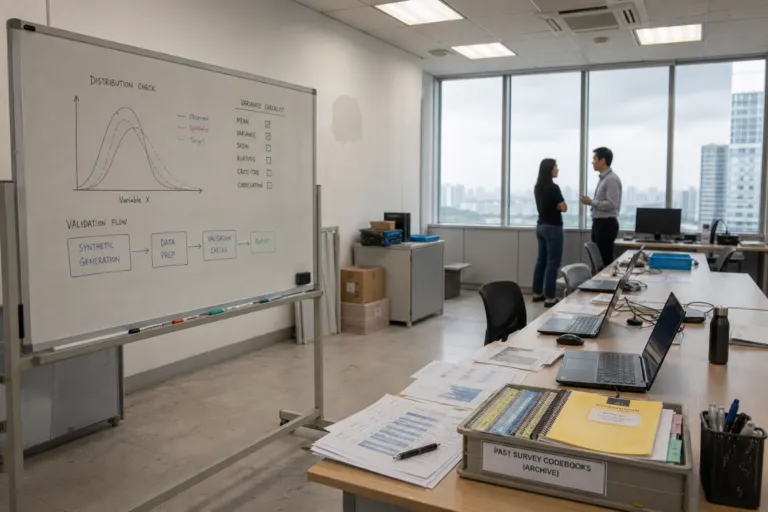
A balanced playbook emerges across the sources: use synthetic personas to explore, then validate with real people. One 2026 practitioner article says these applications work best when validated with at least a small sample of real respondents afterward. Another argues synthetic tools are not designed to replace traditional methods or human insight; they supplement them, acting as an early-stage lens to explore ideas, validate hypotheses, and frame sharper questions before engaging real participants. The most defensible stance is to avoid promises of absolute realism, experiment and test, and reserve final, high-risk decisions for representative market research. That division of labor keeps speed without sacrificing accountability.
How should researchers in Singapore approach synthetic data for market research without over-trusting it?
What reliability figures are reported for AI personas reproducing survey responses?
What can go wrong if synthetic respondents replace representative surveys?
Why does the data source matter so much for synthetic personas?