
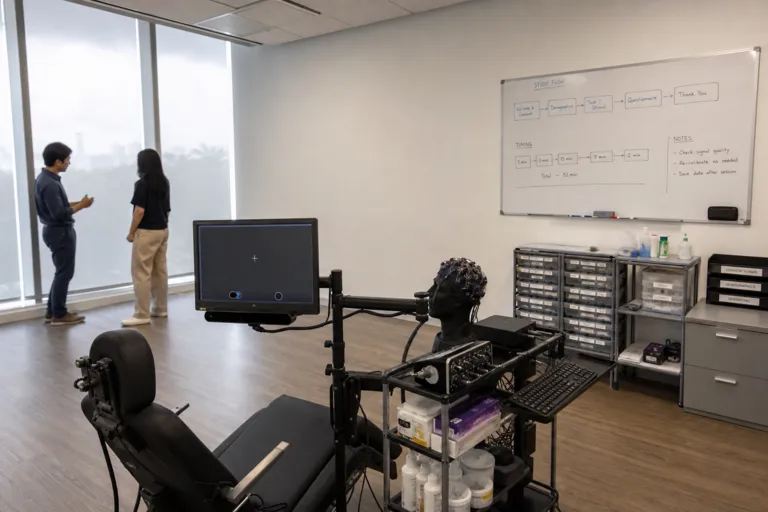
Neuromarketing applies methods from cognitive neuroscience and psychophysiology to marketing questions. It uses tools that measure brain activity, autonomic responses, and perceptual behavior, such as EEG, fMRI, galvanic skin response (GSR), heart rate, eye-tracking, facial coding, and reaction times. A ScienceDirect bibliometric review describes these as neuroimaging and physiological tools used to measure neural responses to marketing stimuli and to aid marketing effectiveness, especially by going beyond self-reported feedback. For teams planning neuromarketing research Singapore projects, this framing matters: it is not a replacement for surveys, focus groups, A/B tests, or sales results, but an added layer of evidence that can help interpret what people do versus what they say.
What neuromarketing can do best is make creative and product decisions more testable. Harvard DCE describes neuromarketing as exposing “real and unfiltered responses” and helping marketers understand motivations behind unconscious choices to buy or not buy, so brands can adapt elements of price, packaging, and campaigns. Straits Research explains that monitoring eye movements and coding facial expressions can show what a consumer looks at, how long they stare, and related signals such as pupil dilation. It also notes that businesses use neuroscience techniques like EEG and fMRI to optimize advertising effectiveness and product design based on subconscious responses. Used carefully, these methods support iteration: you can compare versions of an ad, a pack, or a user flow and see which one better holds attention or reduces cognitive load.
Where the Evidence Is Strong—and Where It Gets Noisy
Some parts of the industry lean on stronger validation than others. Deep Marketing argues that well-conducted fMRI and EEG can be valid in rigorous experimental contexts, and that eye-tracking is useful for UX and packaging. The same source warns that some offerings are “commercial hype,” calling out facial coding as an emotional oracle, neuro-profiling, and subliminal priming at scale as examples of scientific-sounding promises that do not match peer-reviewed support. It cites Lisa Feldman Barrett (2019, Psychological Science) as dismantling the reliability of facial coding as an indicator of emotional states. In practice, this is a reminder that “more biometric data” does not automatically mean “more truth,” especially when small samples and undocumented models are presented as mind-reading.
Market sizing and performance claims vary widely across sources, so Singapore teams should treat global figures as context, not as local proof. Straits Research estimates the global neuromarketing market at USD 1.66 billion in 2025, projecting USD 1.78 billion in 2026 and USD 3.07 billion by 2034, at a 7.07% CAGR for 2026–2034. Mordor Intelligence estimates USD 1.71 billion in 2025 and USD 1.83 billion in 2026, reaching USD 2.53 billion by 2031 at a 6.76% CAGR for 2026–2031, and reports global shares such as EEG at 40.28% in 2025 and advertising and media testing at 51.45% in 2025. Mordor also cites a “landmark study” where EEG-machine learning systems predicted purchase intent with 87.1% accuracy, compared with 64% for surveys. These are global insights; they can guide method selection, but they are not Singapore-specific outcomes.
So what can’t neuromarketing do, even in a sophisticated market? It cannot reliably “know what consumers think” or predict individual purchase decisions with surgical precision, as Deep Marketing cautions. It also cannot substitute for strategy fundamentals; the same source references Byron Sharp’s argument that brand growth is driven by distinctive assets and mental and physical availability rather than introspective “mind reading.” A practical takeaway for behavioral research planning is to use neuroscience measures as supporting signals for pre-testing, segmentation hypotheses, or user-experience optimization, but to keep claims modest and triangulate with traditional research and outcomes. This is the most defensible way to deploy neuromarketing research in Singapore without overpromising what the tools can deliver.
What is neuromarketing in a marketing research context?
What does neuromarketing do well for ads, packaging, and UX?
What are common limitations or “hype” areas to watch out for?
What global figures are often cited about the neuromarketing market?
How should teams approach neuromarketing research in Singapore without overpromising?