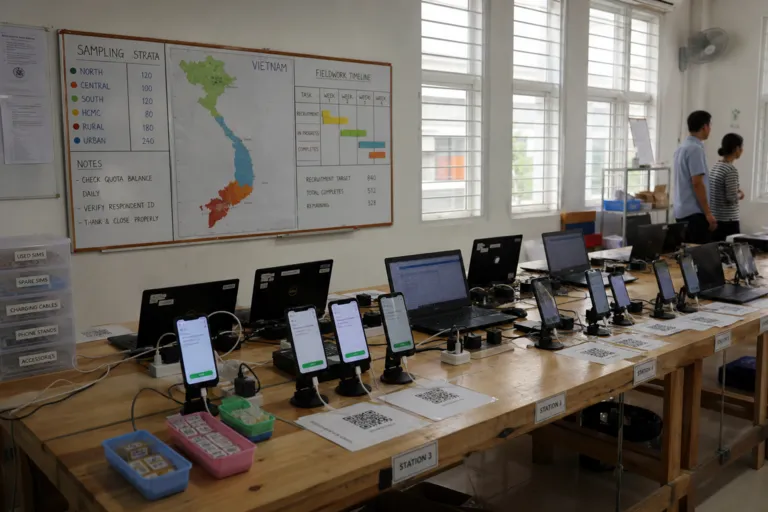
Mobile-first survey research in Vietnam starts with a simple operational truth: smartphones are central to how many people access the internet and digital services. TraceData Research describes a transition from feature phones to advanced mobile devices, supported by expanding 4G and emerging 5G networks, rising internet penetration, and growing digital literacy among younger populations. For researchers, that context changes what “representative” collection looks like. Mobile is not just a distribution channel. It is the environment where attention, task completion, and dropout risk must be managed. Designs that assume desktop behaviors can underperform when respondents are on small screens, switching apps, and answering in short time windows.
Vietnam’s smartphone economy also signals scale and continuity that matter for ongoing panels and tracking studies. Expert Market Research reports the Vietnam smartphone market reached about USD 4.06 billion in 2025, with a projection to USD 4.67 billion by 2035 at a 1.40% CAGR. In the same report, Vietnam’s import of mobile phones and components is described as reaching more than USD 3 billion in the first quarter of 2024. For mobile-led survey programs, these figures support a planning assumption of sustained device availability and a competitive retail landscape. That helps justify investments in mobile-first questionnaire templates, device QA routines, and always-on respondent engagement flows.
Designing Surveys for Vietnamese Smartphone Behaviors
Mobile-first research design should mirror what people actually do on their phones. Expert Market Research notes that average daily smartphone usage in Vietnam is growing rapidly, driven by video consumption, gaming, and mobile payments. That mix implies frequent interruptions and a preference for quick interactions. For surveys, it means using short screens, clear progress cues, and question formats that avoid dense grids. It also suggests scheduling and reminder strategies that respect mobile routines. When respondents are accustomed to content streams and transactional tasks, survey UX should feel equally straightforward: minimal loading, tap-friendly controls, and concise wording that remains unambiguous on small displays.
Sampling and device strategy also benefit from understanding which brands dominate. Statista, citing StatCounter data, reports that as of August 2022 Apple led Vietnam’s mobile vendor market share at approximately 30%, followed by Samsung at around 29%. While vendor share is not the same as operating system share, it is still useful for practical QA coverage. A mobile-first Vietnam survey program should test on high-share device families to reduce formatting errors, media rendering issues, and input problems that can bias completion. When incentives, media prompts, or interactive tasks are used, cross-device consistency becomes part of data quality management.
Fieldwork execution should align with how smartphones enable services and commerce across urban and semi-urban areas. TraceData Research highlights the increasing availability of budget and mid-range smartphones and growth in mobile-based services and applications. Expert Market Research adds that younger users employ smartphones for content creation and online shopping, and that affordable smartphone production can support access for low-income consumers. For survey teams, the practical takeaway is to avoid heavy assets and to keep surveys bandwidth-light and device-tolerant. Use adaptive logic carefully, keep pages small, and plan quality checks that work without assuming long, uninterrupted sessions.
What makes smartphone-first consumer research especially relevant in Vietnam?
Which smartphone vendors are most important to test for survey compatibility in Vietnam?
How do Vietnam’s smartphone usage trends affect survey questionnaire design?
How should teams think about market momentum when planning long-term mobile survey programs in Vietnam?
What is a practical starting point for mobile survey research in Vietnam without overcomplicating execution?