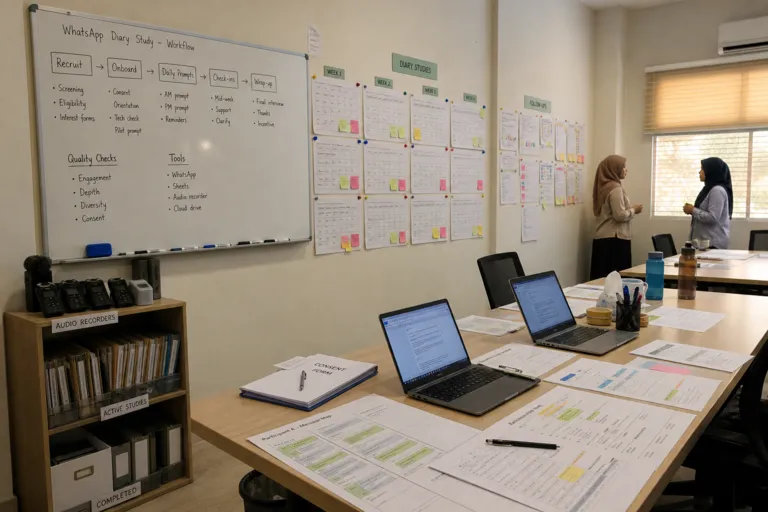
WhatsApp-based research replaces web links, phone calls, and some in-person fieldwork with a chat-first approach. Instead of sending a participant to an external survey tool, a researcher (or automation) asks questions inside a WhatsApp thread where replies arrive like normal messages. Sources describe WhatsApp as having billions of monthly users worldwide and being used in over 180 countries, which matters because it lets teams recruit and run studies in a familiar environment. That familiarity can reduce “inbox clutter” friction and make participation feel more conversational than form-based. For Indonesia-focused projects, this is also compatible with the way WhatsApp often functions as connective tissue across real customer journeys, supporting ongoing contact and follow-up rather than a one-off touchpoint.
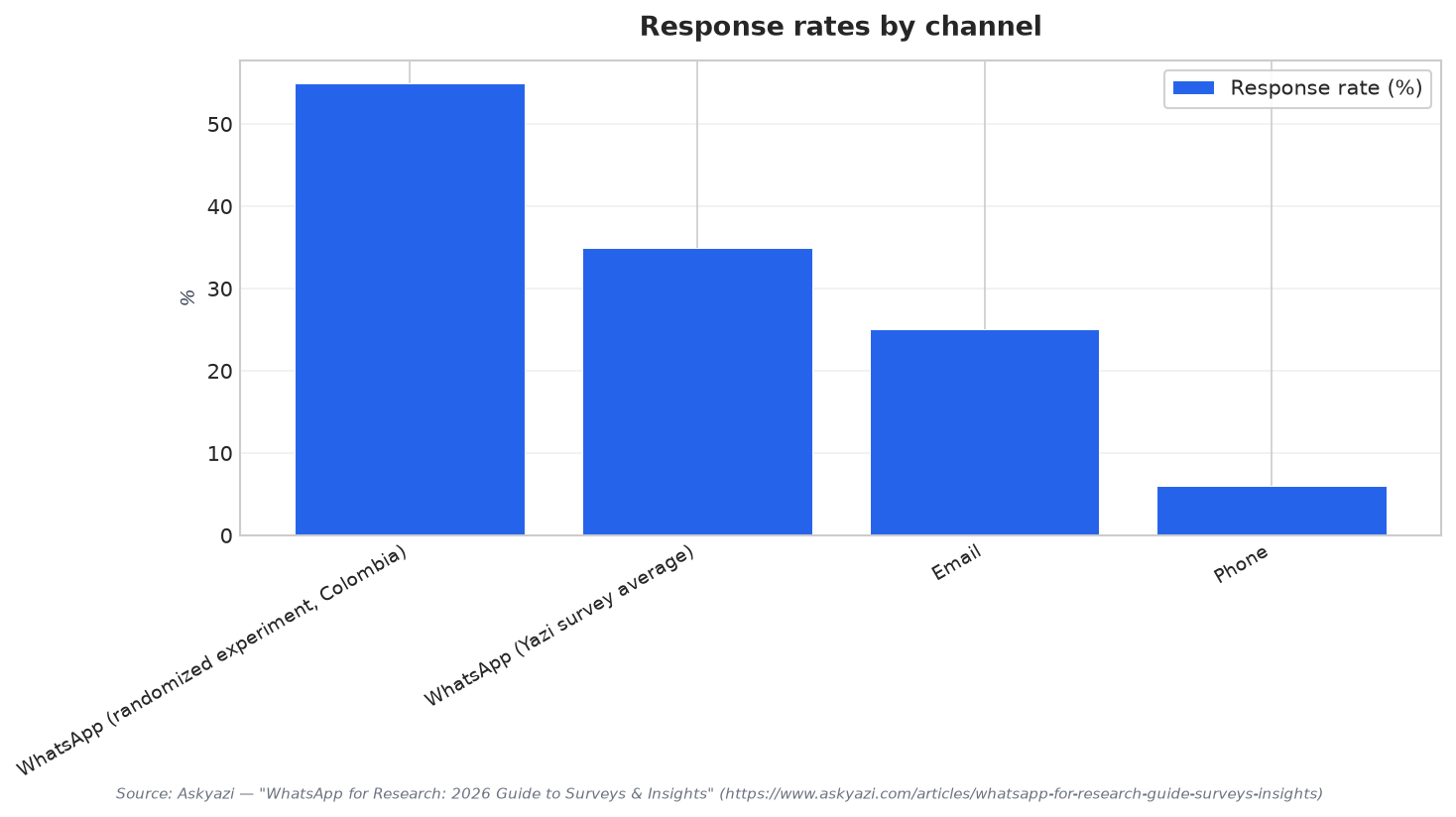
When speed and response volume matter, chat can outperform older modes. One guide cites WhatsApp message open rates commonly referenced in the 90–98% range as a broad industry benchmark, and another states an open rate that “hovers around 98%,” with about 80% read within five minutes (these are presented as general WhatsApp benchmarks, not Indonesia-specific measurements). For response rates, a randomized mode experiment in Colombia found WhatsApp surveys reached 55%, ahead of interactive voice response and well ahead of SMS in the same comparison. The same source also reports that across its own WhatsApp surveys, average response rates are closer to 35%, versus email at 15–25% and phone at roughly 6%. Another source summarizes the effect as WhatsApp surveys getting 3 to 6 times more responses than identical email surveys.
When Diary Studies and Chat Interviews Beat Traditional Fieldwork
Traditional fieldwork is strong when you need deep observation, but it can be slow and resource-heavy. WhatsApp diary studies and interviews can win when you need frequent check-ins, quick probes, or multimedia context without the travel and scheduling overhead. Sources highlight higher candor because participants communicate on a channel used for personal conversation, reducing psychological distance. They also note stronger follow-up engagement for longitudinal designs, with significantly lower attrition than email-based approaches. WhatsApp supports audio diary studies through voice messages, plus images and video inside the same thread. A concrete example cited is TBWA completing over 200 in-depth interviews on WhatsApp in under 24 hours, illustrating why teams reach for chat when timelines are tight.
For “WhatsApp surveys Indonesia” projects, the operational win is that one thread can carry screening, scheduling, short surveys, and diary-style check-ins, while keeping a continuous record of participant interaction. Automation can help a small team manage large volumes of conversations, and sources argue that once a system is running the marginal cost per conversation is small compared with in-person or phone-based work. However, the same materials also flag practical constraints relevant to emerging-market conditions: unreliable mobile networks can cause messages to arrive out of order, and in some rural contexts participants may drop out when their phone battery dies due to lack of electricity. These issues can disrupt question flow and create missing data if you do not design around them.
Design matters because WhatsApp is not a full research stack by itself. One reference guide warns that while WhatsApp supports recruitment and lightweight qualitative exchanges, extended depth interviews may be better handled through dedicated research platforms that improve transcript quality, structured analysis, and compliance controls. It also notes cross-border complexity: WhatsApp numbers are country-specific, and participants may be suspicious of messages from foreign numbers, so multi-country work may require local numbers in each market. Finally, multimedia is a double-edged sword. Voice, images, and video can add context, but analyzing these media at scale requires infrastructure WhatsApp does not provide natively. The best practice is to treat WhatsApp as the participant-facing layer, then plan governance, ethics, and analysis workflows before launch.
What does WhatsApp-based research mean in practice?
What evidence suggests chat surveys can beat email or phone?
When do diary studies on WhatsApp outperform traditional fieldwork?
What are key risks to plan for in WhatsApp research?
How should teams approach WhatsApp surveys in Indonesia without overrelying on the app?