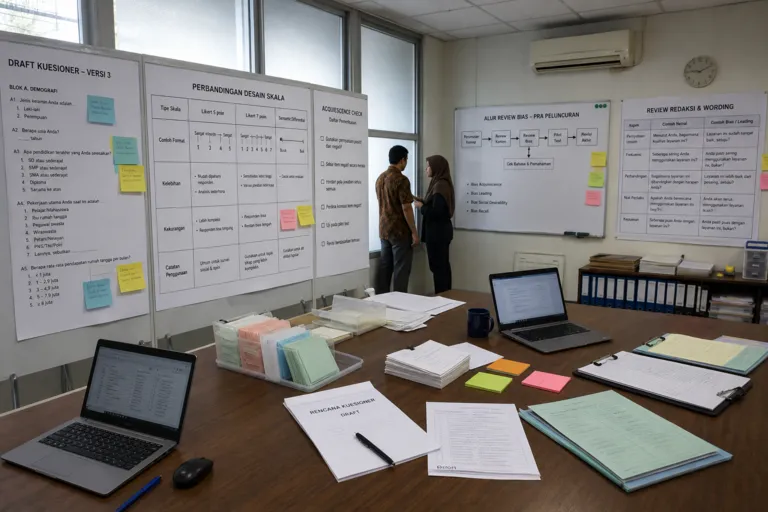
When you plan a market research questionnaire for Indonesian consumers, the biggest risk is not only who you sample, but how your questions push people toward certain answers. Survey bias is any aspect of a survey that negatively influences results by swaying respondents, undermining the authenticity of feedback used for decision-making. Importantly, bias is systematic distortion, not random noise, and it compounds rather than averaging out. That means you can get a clean-looking dataset that is still “confidently wrong” if your design nudges responses in one direction.
Acquiescence bias is one of the most damaging design-stage issues to watch for in Bahasa questionnaires. It is the tendency to agree with survey statements regardless of content, especially when respondents are tired or unsure. Some evidence cited in the sources shows acquiescence can inflate agreement by around 10% on average, and in some cases inflate the estimated prevalence of a belief by upward of 50%. Agree/disagree batteries are particularly vulnerable, as are yes/no and true/false formats. In practice, a sequence of positive statements (for example, “I am satisfied with my job”) can attract more agreement than negatively phrased statements, creating a pattern that looks like strong sentiment but may be a format effect.
Wording and Flow Fixes for Bahasa Surveys (Without Breaking Trends)
To reduce yea-saying, redesign items so respondents must evaluate a specific dimension rather than simply agree. The sources recommend avoiding agree/disagree formats altogether and instead using rating scales that explicitly display the evaluative dimension, with both poles named (item-specific scales such as “How would you rate X?”). Ranking can also help because it forces trade-offs rather than blanket approval. If you have a tracking study, be careful: rewriting a tracking question can break your trend, so run both versions in one overlap wave and then bridge the series with the measured gap or clearly report the break.
Next, audit Bahasa wording for question wording bias and other “nudges.” Bad wording can ruin a survey even with good sampling. Remove leading or emotionally charged language, avoid loaded terms, and fix double-barreled questions that ask two things at once. Watch for absolutes that corner respondents. Also manage order effects: start with broad questions before narrowing focus, and use randomization for answer options where appropriate. If social desirability is a concern, emphasize anonymity and keep language neutral so respondents do not feel pushed toward a “good” answer.
Finally, treat bias reduction as a pre-launch discipline, not a last-minute edit. Some bias is unavoidable, but unrecognized bias is what leads teams to make decisions on distorted information. Review your design choices that create systematic distortion, such as mandatory questions, poor screening, linear flows, leading scales, or overuse of “Other.” For analysis readiness, design items with appropriate scale types and consider checking internal consistency using reliability measures such as Cronbach’s α, Guttman’s λ₆, and McDonald’s ω. Done well, market research questionnaire design Indonesia teams can field Bahasa surveys that are clearer, less leading, and easier to interpret with confidence.
What is acquiescence bias, and why does it matter in surveys?
Which question formats are most vulnerable to yea-saying?
How can I reduce acquiescence without making the survey longer?
How should teams approach market research questionnaire design in Indonesia for Bahasa surveys?
What should I do if I need to rewrite a tracking question?