Expert interviews are most useful when the real goal is a decision, not a transcript. For Indonesia entry, that decision is often a practical go/no-go framed around demand drivers, channel feasibility, pricing logic, and operational constraints. Indonesia also has scale and complexity that can hide false certainty: one Indonesia-focused feasibility guide cites a population of 284 million, GDP growth of approximately 5.11% year-on-year in 2025, and a digital economy estimated at US$ 99 billion in gross merchandise value. It also warns that Jakarta-only research becomes “Jakarta data,” not national reality, noting that Jakarta and Java account for 57% of GDP but only 40% of population. Interviews help you understand what those macro starting points mean for your specific category, segments, and launch plan.
Start by defining what you need to decide, then translate that into expert segments. Guidance on interviewing experts recommends building your mix using broad lenses such as market, customer, competitor, and operator, and then refining by value-chain position, stakeholder type, company type, functional area, seniority, and geography. This structure prevents overconcentration in a single viewpoint and keeps calls focused on “what must be true” for market entry to work. Use experts to clarify how the market is segmented, what units matter, where category boundaries sit, and which demand drivers or constraints should shape your model. Treat interviews as a way to make a market-sizing or business case more realistic, not as a shortcut to a precise market-size figure from scratch.
Sourcing and Running Interviews in Indonesia: Practical Execution
Execution quality in Indonesia depends heavily on language and communication style. One qualitative research guide notes Indonesia is the world’s fourth most populous country, with over 275 million people, and has 200+ million internet users. It is also culturally diverse, with 700+ languages and dialects, and while Bahasa Indonesia is national, regional languages such as Javanese, Sundanese, and Balinese carry strong local meaning. The same guide highlights politeness and indirect communication styles that can obscure true opinions unless moderation is culturally fluent. Practical solutions include bilingual moderators fluent in Bahasa Indonesia, English, and relevant local dialects, plus simultaneous translators so international teams can follow in real time. Online formats can also help with speed and access, including online focus groups with four to six people.
Plan sample and budget around saturation and the business question. The Indonesia qualitative guide suggests thematic saturation for in-depth interviews (IDIs) typically occurs at 10–15 respondents per segment, and for focus group discussions (FGDs) 3–4 sessions per segment is usually sufficient. It also states IDIs often run 45–90 minutes and are ideal for sensitive topics, B2B decision-maker work, and situations where social desirability bias could distort group discussion. For budgeting context, the same source gives an example for 10 IDIs in Jakarta (recruitment, interviews, transcription, thematic analysis) of Rp 40–80 million, and FGD sessions at Rp 15–25 million per session. Use these ranges as planning anchors, then adjust based on segments, islands, and language needs so you do not mistake convenience sampling for national insight.
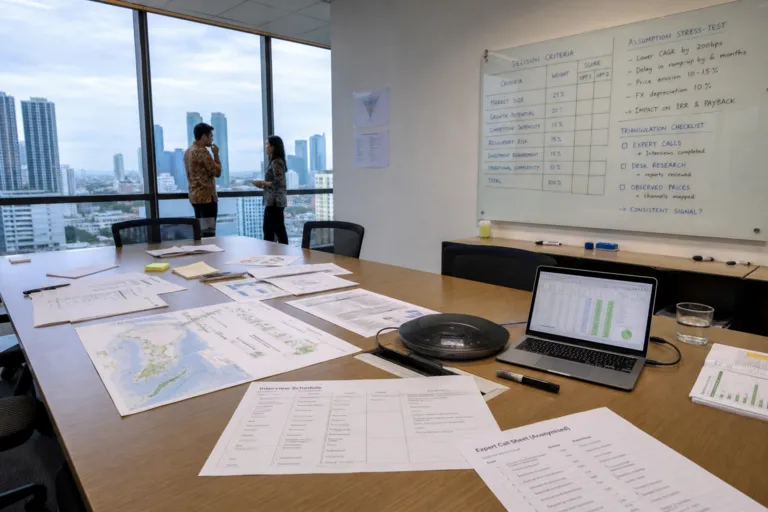
After you collect interviews, turn them into decisions by triangulating. A market-sizing methodology describes a 5-step triangulation approach and argues the difference between a deck that gets pushed back on and one that becomes strategy often depends on executing 15–25 expert interviews and stitching insights into a coherent model. It also warns against relying on large research firms as “independent validators” of their own published numbers, recommending smaller, specialized analysts whose incentives are not tied to defending prior estimates. In practice, for expert interviews on Indonesia market entry, combine expert perspectives with desk research and commercially observable data, then set explicit go/no-go gates tied to pricing logic, acquisition cost validation, break-even timeline testing, and operational readiness. This is how interviews reduce risk without replacing financial modeling.
How do expert interviews support Indonesia market entry decisions?
How many in-depth interviews should I run for Indonesia qualitative work?
What is a realistic budget range for 10 IDIs in Jakarta?
Why is Jakarta-only research risky for national entry planning?
How should I approach expert interviews for Indonesia market entry without relying on one viewpoint?