Budgeting for the cost of market research Southeast Asia starts with one practical truth: there is no single price. Sources emphasize that budgets vary by methodology, how hard it is to reach the audience, incentive strategy, tools, and project complexity. Most projects also mix primary research (bespoke, new data collected for your questions) with secondary research (desk research using existing reports and published datasets). Primary research is more expensive and more time-consuming, while secondary research is typically less expensive and faster, but less tailored. A common planning pattern is to begin with desk research to map the landscape and then run targeted primary work to validate product-market fit and reduce decision risk.
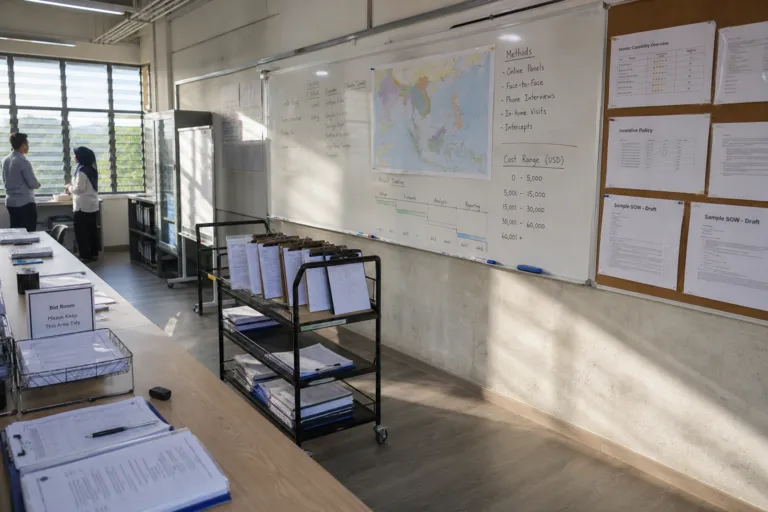
For 2026 budgeting, method-based ranges provide a useful anchor, but some published figures are described as global reference ranges rather than Southeast Asia guarantees. One 2026 benchmark lists in-depth interviews (IDIs) at USD 5,000 to USD 15,000 per 10–15 interviews, and focus groups at USD 7,000 to USD 20,000+ per group. The same source cites focus group incentives often at USD 75–150 per person. Quantitative ranges include online surveys at USD 5,000 to USD 15,000+ for 400 responses, phone surveys at USD 15,000 to USD 30,000+ for 400 responses, mail surveys at USD 10,000 to USD 25,000+ for 400 responses, and in-person surveys at USD 20,000 to USD 50,000+. Another 2026 update also estimates USD 5,000 to USD 15,000+ for 400 survey responses, reinforcing online surveys as a budget-friendly benchmark when the audience is not unusually difficult.
How to Add Southeast Asia Locale Signals to Your Budget
To keep locale fidelity, pair method benchmarks with country-specific signals where the sources provide them. For Singapore, one guide states focus group costs start from SGD 2,000. This is a Singapore-only reference point, but it can help you sanity-check entry-level qualitative pricing in a regional hub. For Vietnam, one market research guide gives an average desk research cost of approximately JPY 100,000 to 500,000, noting simple reports are inexpensive but costs rise with man-hours, especially when detailed translation and analysis of local Vietnamese language materials are included. That Vietnam-specific range also supports a common efficiency strategy: use desk research early to narrow the fieldwork questions, then run field research to clarify true consumer intentions that are hard to see in secondary sources.
Your provider model also shapes spend and timelines, which is why “average cost” can mislead. One 2026 breakdown estimates market research can run from USD 0 to USD 50,000+ per project: traditional firms charge USD 15,000 to USD 50,000 for a custom study over 4 to 12 weeks, while AI-powered research tools can deliver automated reports for USD 0 to USD 29 in minutes. The same source lists DIY paid tools at USD 0 to USD 300 per month, with 10 to 40 hours of your own time per project and out-of-pocket spend under USD 2,500. It also notes that an in-house market research analyst has a median US salary of about USD 77,000, and a fully loaded annual cost of USD 150,000 to USD 175,000 once benefits, tools, and overhead are included (this figure is US-specific).
Finally, align your Southeast Asia budget expectations with how the industry is operating globally, while keeping the geography explicit. One 2026 report states the global market research industry was forecast to bring in USD 140 billion in revenue in 2024, up from USD 130 billion in 2023, and that it grew by 37.25% from USD 102 billion in 2021 to USD 140 billion in 2024. It also reports online/mobile quantitative services accounted for 35% of worldwide market research company revenues in 2022, and that online surveys are the most used quantitative method, with 85% of market research professionals saying they use them regularly. In practice, these global signals support a budgeting approach for Southeast Asia: define the decision you need to make, choose the lightest method that can answer it, and spend on harder-to-reach audiences and higher-touch moderation only where it changes the decision.
How should I estimate the cost of market research in Southeast Asia without a single “standard” price?
What are typical 2026 ranges for surveys, interviews, and focus groups?
How do primary and secondary research change the budget?
How do provider options change pricing and speed?