

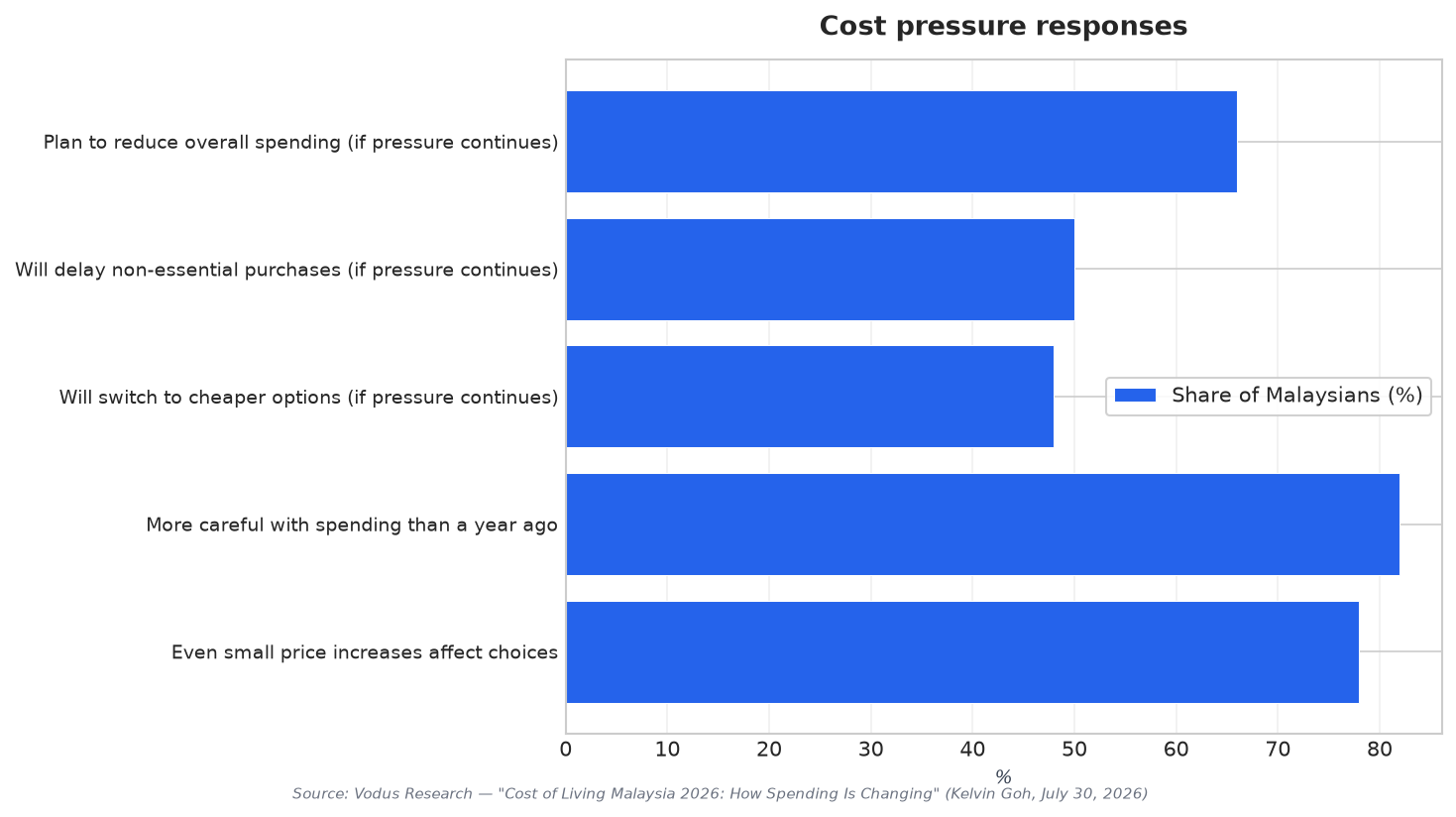
Cost-of-living pressure in Malaysia is changing how people buy, not whether they buy. Vodus Research’s Malaysia Financial Sentiment 2026 study describes households as more deliberate, selective, and sensitive to price even as they keep paying for essentials. Only 11% of Malaysians say they can spend without financial worry. At the same time, 82% say they are more careful with spending than a year ago, and 78% say even small price increases affect their choices. For pricing teams, this is the practical reason to revisit assumptions about demand response. You can still have demand present, but it can become far more conditional on “clear affordability” and “meaningful value” before shoppers commit.
In this environment, price elasticity research Malaysia teams run should focus on retesting, not just reusing old benchmarks. One reason is that elasticity can shift across price ranges and across economic conditions. RGM Academy highlights that price sensitivity is not guaranteed to rise uniformly in difficult times, citing research that finds countercyclical effects in some categories, procyclical effects in others, and noncyclical patterns elsewhere. It also shows why break-even math matters. In a worked example, dividing an 11.1% fall by a 5% rise produces a break-even elasticity of -2.22, and the price rise needs testing when that break-even sits inside the plausible range. The message is simple: when uncertainty brackets your break-even, you test before scaling a price move.
How to Test Demand Sensitivity When Budgets Tighten
Method matters because price is rarely the only thing moving. MCP Analytics warns that seasonality, marketing campaigns, competitor actions, economic conditions, and product availability can all influence sales volumes, which can distort an elasticity estimate if you treat price as the only driver. It also notes a common failure case: if prices barely changed during the period you analyze, you do not have enough variation for robust estimates. Best practice is to span multiple price changes over a period long enough to cover your seasonal pattern, or run controlled experiments such as A/B testing across markets or segments. MainBrain Research frames elasticity work as combining demand data, observed price sensitivity, and willingness-to-pay research to test outcomes across different price points before mistakes get expensive. It also cites industry analysis suggesting a 1% price improvement can lift operating profit by 8–11% in many industries, which raises the stakes for getting the sensitivity right.
Malaysia-specific research also shows why “necessities” behave differently from discretionary spending under pressure. A Malaysia electricity study estimates price and income elasticity of electricity consumption using annual data covering 1980–2009, and reports that income elasticity was less than unity, indicating electricity as a necessity good to people in Malaysia. That does not mean electricity demand is immune to price changes, but it does support a planning mindset: in essential categories, consumers often protect usage more than they protect lifestyle extras. Vodus’s 2026 findings align with this behavior pattern. If financial pressure continues, 66% plan to reduce overall spending, 50% will delay purchases that are not essential, and 48% will switch to cheaper options. It also flags lifestyle spending—eating out, food delivery, travel, and leisure—as likely to face the greatest reductions as households attempt to protect essential expenses.
Finally, not every “elasticity” question is about consumer goods. An MDPI study on Malaysia’s housing market uses annual data from 1990 to 2024 and expresses variables in natural logarithms so coefficients can be interpreted as elasticities. It notes evidence that housing prices have consistently outpaced household income growth, increasing pressure on housing affordability, particularly among low- and middle-income households. For commercial teams, the cross-sector lesson is consistent: when affordability tightens, demand participation can depend more heavily on economic capacity, and sensitivity tests should be grounded in the realities of the period you are pricing into. With budgets tight and “small price increases” already shaping choices for many, retesting elasticity becomes a practical safeguard, not an academic exercise.
Why does price elasticity research in Malaysia need retesting in 2026?
What Malaysia data signals higher day-to-day price sensitivity?
How can a team check whether a planned price rise breaks even?
What are common pitfalls when estimating elasticity from sales data?
Which spending areas may be most exposed when households cut back?