Taglish open-ended survey answers are rich. They also create a coding bottleneck when teams rely on fully manual verbatim coding. The goal of AI text analytics in the Philippines is not to “replace” analysts, but to remove repetitive work so people can focus on interpretation. Multiple survey analysis guides describe how AI can accelerate open-ended response analysis through automated coding, trend and topic detection, and sentiment analysis that adds context beyond what respondents literally say. The most practical approach is to combine AI speed with human judgment, so that local expressions, mixed language, and intent remain visible in the final story.
A workflow mindset helps, especially when Taglish introduces spelling variation, slang, and switching between English and Filipino within a single line. One recommended process starts with exporting raw responses with response IDs and useful metadata such as market, segment, or language. It also warns teams to avoid including personally identifiable information to support privacy. From there, AI-assisted cleaning can detect duplicates, fix typos, filter irrelevant entries, and detect languages. A human familiarization pass still matters. Reading a sample of responses helps an analyst understand tone and recurring issues before any model assigns themes.
How to Code Taglish Faster Without Flattening Meaning
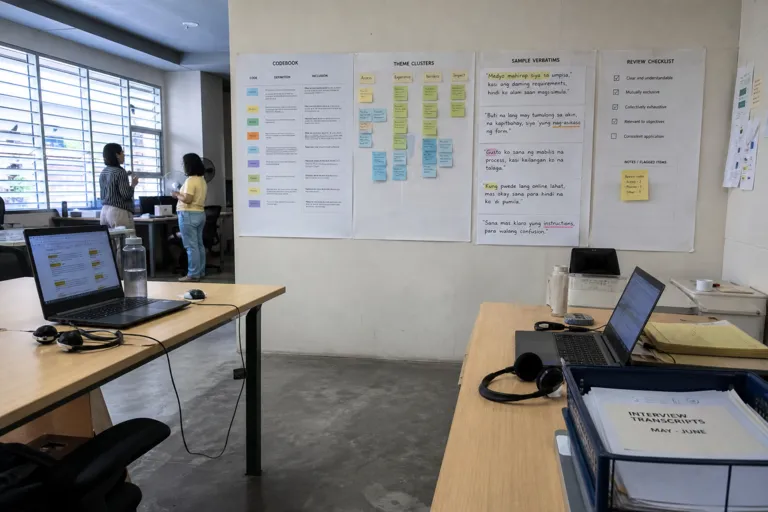
For coding, start with a human-drafted codebook aligned to the research objective and business context. One guide defines a codebook as the set of themes likely to appear, such as Price, Battery Life, Customer Support, or Delivery. That codebook is then provided to the AI tool for auto-coding. The AI can match responses to pre-defined categories and also suggest new themes by flagging recurring phrases not yet represented. This matters for Taglish, where intent may be expressed in short mixed phrases that would not appear in an English-only framework. Keep a review loop. Analysts should inspect edge cases and refine the codebook so the taxonomy reflects real respondent language.
Time savings are the clearest operational win. Displayr’s survey analysis overview describes reducing open-ended coding from days to minutes, and another methods guide notes that AI can reduce coding time from days to hours depending on the approach. Use fast methods as a first pass, not a final verdict. Sentiment analysis can label responses as positive, neutral, or negative by detecting emotional tone, but the same source cautions that it misses irony and sarcasm and can flatten mixed reactions. Keyword and phrase extraction can quickly surface common vocabulary, while topic modeling groups responses into thematic clusters based on word co-occurrence patterns for exploratory work when you do not yet have a stable codebook.
Tool choice should follow your nuance requirements. A text analysis tools roundup notes that some platforms support multilingual verbatim coding and can create summaries of topics and themes, as well as perform sentiment analysis. Another tools list highlights “context-aware AI” that identifies themes based on intent and nuance rather than only keywords, while also warning that keyword-driven coding can miss nuance. Put governance around outputs. Preserve the original verbatims for traceability, store coded results in a structured file, and keep researchers responsible for methodology decisions. With that structure, AI can help teams code Taglish feedback faster while keeping Filipino meaning, tone, and context in view.
How can AI text analytics in the Philippines help with Taglish survey responses?
What is a practical first step before using AI to code open-ended responses?
Why does a codebook still matter when using AI?
What is a key limitation of sentiment analysis for open-ended survey text?