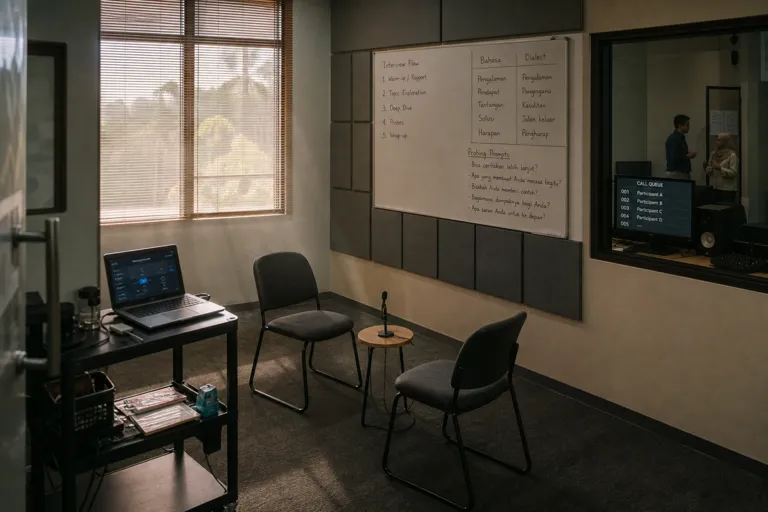
Indonesia is a high-priority research market because it combines scale, digital acceleration, and cultural diversity. It is the world’s fourth most populous country, with over 275 million people, and it has 200+ million internet users with mobile-first adoption. Those conditions can push research teams toward faster cycles and broader coverage, especially when decisions depend on how people shop, pay, and communicate in daily life. But speed alone is not enough. In Indonesia, qualitative research also has to capture context, including negotiation norms, festival-driven shopping, and differences between large cities and smaller towns.
Language is where many studies succeed or quietly fail. Indonesia is home to 700+ languages and dialects. Bahasa Indonesia is the national language, yet regional tongues such as Javanese, Sundanese, and Balinese carry strong cultural significance, and multilingual speakers may switch between Bahasa and regional languages during a session. Sources also flag politeness and indirect communication styles, which can obscure true opinions if moderation does not probe carefully. This is why teams exploring AI-moderated interviews Indonesia should think beyond a simple “language count” and focus on whether the moderation experience actually fits the way participants speak.
What “Multilingual AI Moderation” Really Means in Practice
One source distinguishes three very different setups for multilingual AI interviewing: translated, localized, and tuned. A translated flow runs interview logic in English and uses machine translation in and out, which can degrade register, idiom, and probing. Localized approaches professionally translate prompts in advance, which can work well for more structured studies with limited probing. Tuned systems go further by evaluating and adjusting moderation, probing behavior, and speech recognition per language, which helps keep probes relevant but is more expensive and often leads to narrower coverage. The same source warns that code-switching is especially hard, because real consumers do not speak one language at a time while systems are often built as though they do.
When the language layer is right, AI moderation can remove operational bottlenecks. A guide to scaling AI-moderated research highlights running hundreds of simultaneous interviews instead of sequential human moderation, with 24/7 availability across time zones and languages. That same source also describes recruitment from panels spanning 30+ million verified respondents across 45+ countries and 100+ languages, plus fraud detection monitoring. Another platform description frames “qual at quant scale” as hundreds or thousands of adaptive interviews, citing examples such as 200+ panel interviews in 24 hours and 1,000+ per week, with 20–30 minute conversations that ladder 5–7 levels deep. A verified review quotes a workflow of 50 interviews per week across different languages and countries.
Quality still depends on human research skill, even with automation. A qualitative AI tools overview states that none of these systems replaces the researcher: study design, hypothesis framing, and interpretation still require human expertise, while AI removes manual steps that slow work down. On the participant side, a Cint webinar recap says a majority of respondents surveyed by Cint are happy to take part in sessions led by AI moderators, while also flagging risks like sample bias across different languages, demographics, and cultures. For Indonesia, a practical approach blends strong study design, careful screening, and language-aware moderation with local cultural understanding—so teams can scale without losing nuance.
Why do AI-moderated interviews matter for research in Indonesia?
What makes multilingual qualitative research difficult in Indonesia?
How can teams evaluate language coverage for AI moderation?
What scale can AI-moderated qualitative programs reach?
How should teams approach AI-moderated interviews in Indonesia without losing rigor?