
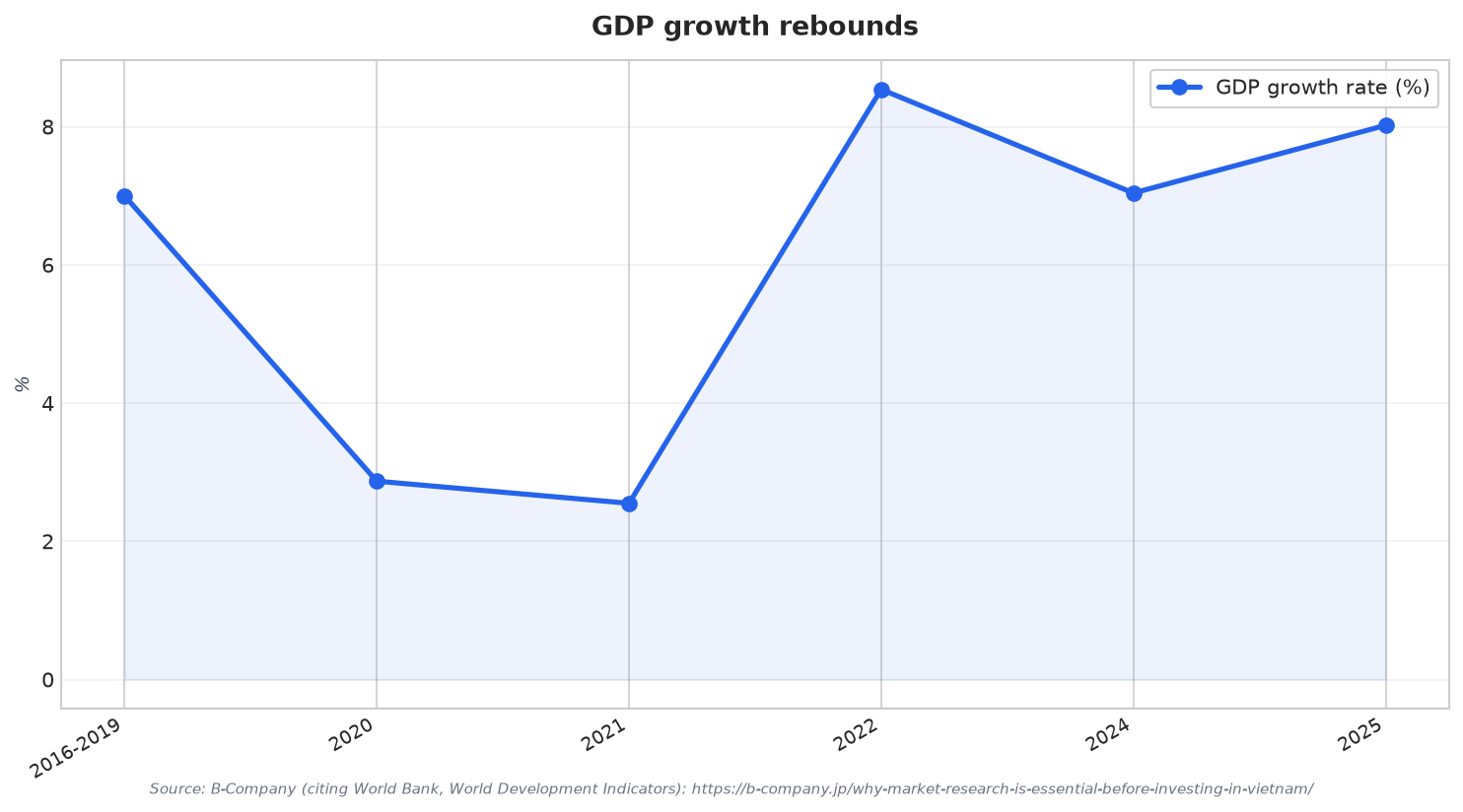
Vietnam is often shortlisted because the macro story is strong, but macro strength is only a starting point for an investable entry thesis. World Bank indicators cited by B-Company show GDP growth remained close to 7% during 2016–2019, then slowed to 2.87% in 2020 and 2.55% in 2021, before rebounding to 8.54% in 2022, accelerating to 7.04% in 2024 and 8.02% in 2025. Over a similar window, FDI net inflows increased from USD 12.6 billion in 2016 to USD 20.17 billion in 2024. Use this as context. Then plan research that answers the questions macro data cannot: where demand exists, how buyers decide, and how competition and regulations work in practice.
Stage 1 is preparation, because the Vietnam Market Research Guide from Liiily Asia states that 80% of research success is determined before starting. Begin by defining the decision your research must unlock, such as choosing an entry mode, selecting sales channels, or setting a viable first-city launch. Next, limit the scope. Vietnam runs north to south, and the source warns that culture and temperament differ greatly by region, so national averages can hide regional realities and inflate costs. Also define target attributes clearly, not loosely. The guide gives an example criterion: households with a monthly income of $1,000 or more. Finally, write a hypothesis of what you expect to find so interviews and data checks can confirm or falsify it.
A Staged Research Plan That Reduces Risk Before Capital
Stage 2 is low-cost orientation plus reality checks. Arches Global notes that government portals such as the General Statistics Office (GSO) and associations like VECOM and VAMA publish useful data and are the right starting point, but public data is decentralized, often lags market movement, and rarely reaches commercial granularity. So treat desk research as the baseline, not the answer. MAI International’s approach is to work backward from the decision you need to make and combine modules such as desktop research, regulatory research, trade data analysis, and company interviews. This structure helps you move from “interesting market” to evidence you can use in a go/no-go decision.
Stage 3 is execution feasibility: channels, partners, and compliance gates. MAI highlights practical questions that desk research alone cannot solve, including identifying local competitors and price ranges, and understanding actual sales channels and distribution flow. In parallel, build what JTMA calls a Regulatory Friction Map and apply a strict gate rule: do not promise timelines or scale beyond a pilot until requirements, documentation, and responsible parties are verified. This is where many teams fail by committing capital or inventory before regulatory gates are cleared. Your output should be a short list of entry options and what must be true for each one to work in your category.
Stage 4 is pilot-first validation and then an entry-mode choice grounded in evidence. Ascentium describes distributor-led routes as the fastest, safest option for many international companies, while noting that a representative office (RO) is only for research and promotion, with a 15-day setup and no invoicing. It also notes a trading company charter capital is often in the US$15,000–50,000 range, and must be contributed within 90 days, with licensing implications for direct import and distribution. This is where market entry research Vietnam teams should connect findings to next actions, as MAI recommends: moving from a report to channel search, strategy refinement, and negotiation support, while scaling only after repeatable sales and clarified compliance responsibilities.
How should I start market entry research for Vietnam before investing?
Which Vietnam macro indicators can frame an initial market screen?
Why isn’t desk research enough for a Vietnam entry decision?
What is a Regulatory Friction Map, and when should I build it?
What early setup facts matter when choosing an entry mode?