In Vietnam’s B2B market, it is easy to assume a lost deal was about price, features, or timing. The problem is that sellers and buyers often disagree on the real reason. Corporate Visions reports that sales reps and buyers disagree on why deals are lost 50% to 70% of the time, based on 100,000+ purchase decisions. That gap matters when you are losing to local and regional competitors, because you may be fixing the wrong thing. CRM dropdown fields can create confidence in data that is “flat-out wrong,” and Clozd found CRM competitor tags disagreed with buyer interviews in nearly 7 of every 10 deals. If leadership relies on those fields, competitive strategy can drift away from what buyers actually experienced.
A strong win-loss program is built around structured buyer interviews, not internal post-mortems. Multiple sources warn that rep-only narratives skew toward safe explanations, especially “price,” because it is easier than admitting weak discovery or unclear requirements. Anova Consulting Group reports that 60% of the time salespeople do not have a complete and accurate understanding of why they lost. Win-loss analysis corrects that by capturing several contributing factors, not a single disposition code. Clozd’s count is that interviews typically surface 4 to 5 factors that decided the deal. This is the core discipline behind win-loss analysis Vietnam B2B teams can use to learn what local and regional rivals framed, promised, or proved during the evaluation.
What You Should Measure: “No Decision,” Price, and Competitor Framing
When you investigate losses, do not limit the scope to the competitor you “lost to.” Harvard Business Review found that 40% to 60% of deals end in “no decision,” based on 2.5 million recorded conversations. That means your most common competitor may be the status quo, even when a local vendor is in the mix. Also treat price carefully. User Intuition classified price as the primary driver in 18.1% of lost-deal interviews, even though 62.3% of buyers initially cited price. The takeaway is not that price is irrelevant. It is that price can be a contributor while other factors, such as evaluation criteria being set before you engage, can be decisive.
Execution matters as much as product. Stealery argues most deals are decided in the middle of the sales cycle, not at the final proposal, so your win-loss questions should focus on how the buying committee evaluated options and when criteria locked in. Gartner is cited by Stealery as finding that companies that formally interview buyers after close improve win rates by an average of 15–30% within two quarters. To increase candor, do not have the account executive conduct the interview. B2BLead recommends a neutral party, such as a product marketer, researcher, customer success manager not on the deal, or an external firm. Stealery suggests timing outreach within two to four weeks of the deal closing to keep details fresh.
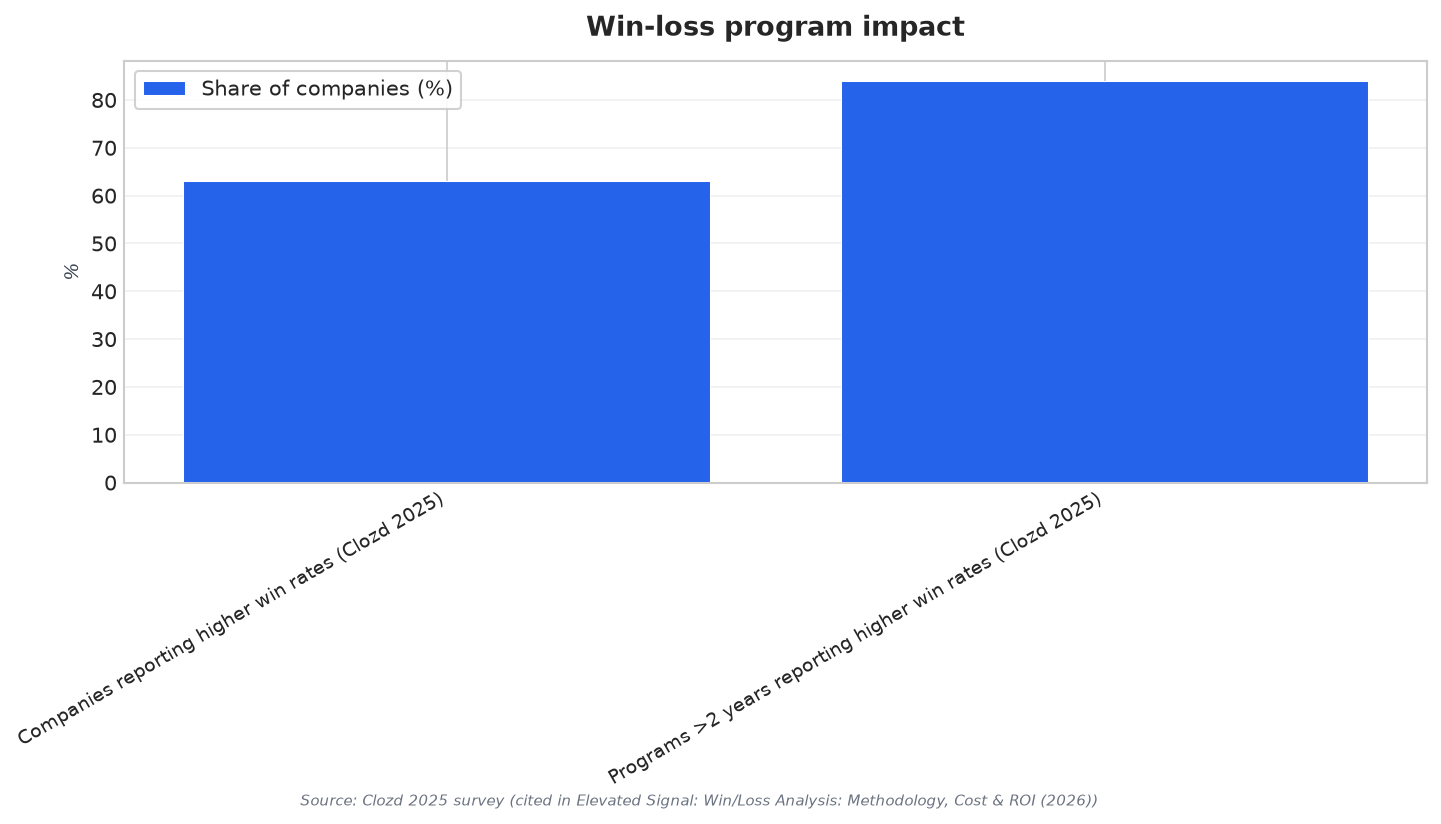
Make the output operational, not academic. Segment findings by competitor and deal type so you can see patterns that explain losses to local and regional alternatives. Revenue Grid notes that a win-loss ratio is wins divided by losses, and gives an example where a ratio of 1:3 means you win one deal for every three you lose, with ratios between 1:3 and 1:4 described as common for B2B sales. Use the ratio as a trend signal, then connect interview insights to action: a process change, a message change, or a battlecard update. Clozd’s 2025 survey found 63% of companies reported higher win rates from win-loss analysis, and 84% of programs running longer than two years did. The same survey found teams using a third-party provider were twice as likely to be satisfied with their feedback (70% vs. 34% in-house), which can matter when you need honest clarity on why competitors win.
Why can CRM “closed-lost reasons” mislead B2B teams in Vietnam?
How often do B2B opportunities end with no vendor selected?
Is price usually the real reason deals are lost?
What changes outcomes in win-loss analysis for Vietnam B2B teams?
How should win-loss analysis in Vietnam’s B2B context be structured?