A strong research program starts with a clear definition. Customer experience (CX) research is about understanding how customers perceive your brand across every interaction, from awareness and consideration to purchase, support, and long-term loyalty. It goes beyond asking if people are satisfied. It explores emotions, values, and friction points across the journey, so teams can anticipate what customers want next, adapt to new technologies and behaviors, and align improvements with what matters most. This matters because experience is a purchase driver: PwC found 73% of customers cite experience as an important factor in purchasing decisions, and Gartner reports 81% of companies expect CX to be their primary competitive differentiator.
For customer experience research in Thailand, program design must reflect how customer interactions actually happen in-market. One Thailand-focused guide notes that CX runs through LINE, Pantip, and platform-fragmented digital channels that global CX frameworks were not built to handle. That practical detail should shape your touchpoint map, sampling plan, and listening posts. At the same time, remember the difference between customer service feedback and CX research. Customer service feedback often covers a single interaction, while CX research captures perceptions across all touchpoints, including marketing, digital platforms, in-store interactions, and post-purchase engagement. A Thailand program should connect these threads, not treat them as separate projects.
Build for Thailand’s Feedback Reality, Not Just Your Dashboard
Thai-market research must also account for cultural dynamics that can distort standard metrics. One Thailand CX analysis describes contexts where direct negative feedback is socially suppressed, creating a risk that customers give five stars to experiences they found frustrating, then stay silent and disappear. The same source points to inflated CSAT scores that remain consistently high at 4.2–4.8 out of 5.0 while structural service failures accumulate. This is why methodology matters. A Thailand measurement guide warns that standard approaches can produce misleading results, so your program should combine quantitative scores with diagnostic methods that explain “why,” such as interviews, user testing, and open-ended feedback analysis, and then validate patterns across multiple channels.
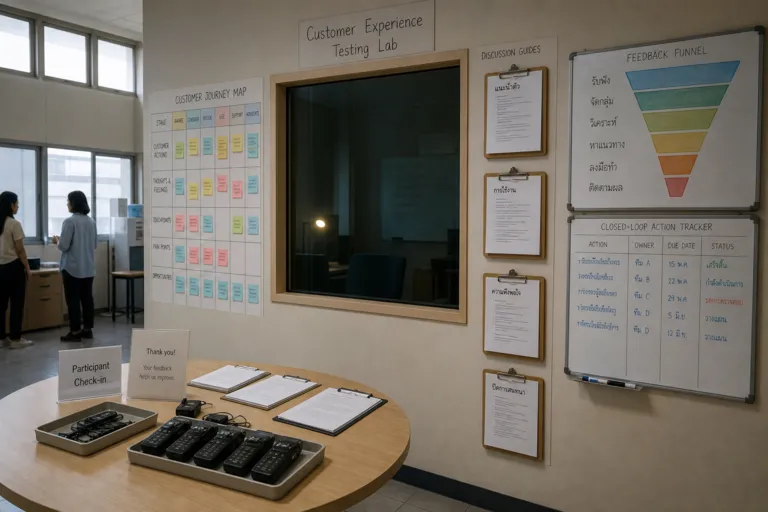
Operational design is what turns insight into outcomes. Consider structuring the program around a closed-loop process: capture feedback, analyze it, route it to owners, and verify follow-up with customers. One platform example for Thailand combines NPS+, journey dashboards, sentiment analysis, workflow automation, and closed-loop feedback tools in one system, emphasizing that the goal is not only collecting more data. Keep your research cadence steady enough to track fast-changing expectations, especially as AI and chatbots reshape customer interactions and personalization becomes the norm. The payoff can be meaningful: one CX research guide states that brands prioritizing customer experience grow revenues 4–8% faster than competitors.
Finally, align your Thailand CX research program with broader investment signals so it is funded and governed like a business system. Globally, the customer experience management market was valued at $15.5 billion in 2025 and projected to grow from $17.7 billion in 2026 to $47.7 billion by 2033, at a CAGR of 15.2%. North America held the largest revenue share at 42.4% in 2025, which is useful as context on where CX investment is most mature, but not a proxy for Thailand. For Thai organizations, the practical takeaway is to treat CX as a board-level discipline: define the journey questions you need answered, select methods that reduce polite-but-misleading responses, and build governance so insights drive changes across digital, frontline, and after-sales experiences.
What is customer experience research, and how is it different from customer service feedback?
Why should a Thailand CX research program be designed differently?
What Thailand-specific risk can distort CX survey results?
How can teams turn CX insights into action, not just reports?
How should I approach designing a customer experience research program in Thailand?