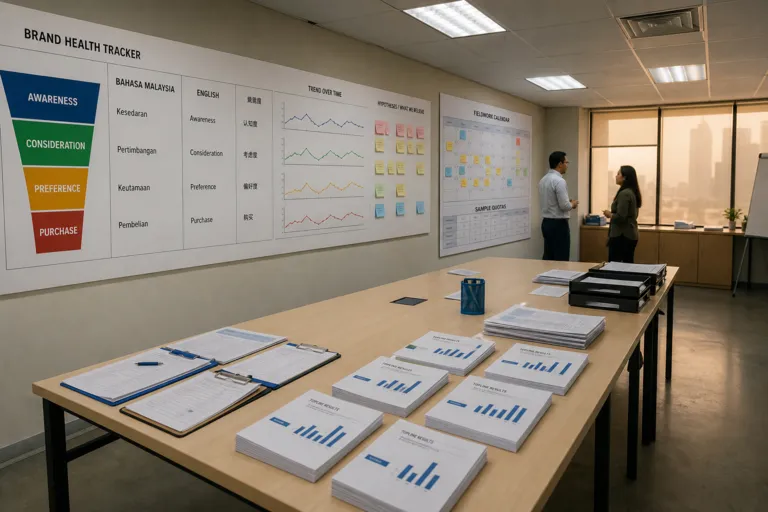
Brand health tracking is the continuous measurement of how a brand is perceived by its audience, using core metrics such as awareness, consideration, preference, and loyalty over time. It matters because sales and social metrics show what already happened, while perception metrics help explain what may happen next. Several sources stress that tracking should be ongoing, because sentiment can shift quickly due to a competitor move, a viral moment, or a product misstep. For brand health tracking Malaysia programs, this means designing a tracker that can be repeated on a dependable cadence so leaders can act on early signals rather than waiting for revenue to confirm a decline.
To measure funnel strength across Malay, Chinese, and Indian consumers, the first step is structure. The classic funnel (awareness, consideration, purchase) is still useful for diagnosing where conversion weakens, and analysis of the funnel helps establish where in the awareness chain changes occur and where marketing efforts should focus to improve conversion. But measurement quality matters as much as metric selection. One best-practice source emphasizes that panel quality is crucial for consistent tracking, and recommends strengthening quality controls through attention checks, trap questions, and inconsistency flags. This is especially important when you split reporting by community, because the tracker needs to separate real shifts from sample noise.
Move Beyond a Uniform Funnel: Add Outcome-Led Brand Strength
Several marketers still treat the funnel as a proxy for brand health, but one source argues that uniform brand tracking can fail modern brands as consumer journeys become more fragmented and brand interactions more nuanced. A proposed alternative is to shift from measuring inputs to understanding outcomes by quantifying brand strength as a composite of Brand Choice and Brand Premium. This approach is positioned as directly correlating with commercial performance, and the same source states that, across categories, brand strength accounts for up to 30% of revenue—and even more for power brands. In practice, pairing funnel diagnostics with this outcome-led view helps Malaysia teams evaluate whether awareness growth is translating into choice and pricing power within each consumer group.
Segmented tracking becomes more actionable when it is designed to explain “why” numbers move, not just whether they moved. Brand health is described as a measure of how well a brand performs against objectives and customer expectations, tracked through perception metrics such as awareness, familiarity, consideration, preference, and advocacy. Another source expands typical KPIs to include brand recall, reputation, equity, satisfaction, and loyalty. When reporting across Malay, Chinese, and Indian consumers, keep the same questions and competitor set wave after wave, then compare where each group diverges: who remembers you, who places you on a shortlist, and who advocates. That consistency is what turns subgroup cuts into decisions you can defend.
Finally, use the measurements to diagnose commercial risk and opportunity. A brand strength index can be compared to revenue share to identify two scenarios: under-leveraged brands with strong perception but weaker sales due to gaps in activation, and over-leveraged brands where market share outpaces brand strength, signaling reliance on short-term tactics like discounts and promotions. The action differs by diagnosis: under-leveraged brands focus on activation fixes, while over-leveraged brands prioritize long-term brand building such as strengthening salience, emotional ties, and distinctiveness. In a Malaysia context, this logic can be applied separately by community so you can see where conversion or equity is being left on the table.
What does brand health tracking measure over time?
How can funnel analysis help improve brand performance?
Why add brand strength metrics beyond the classic funnel?
What does the brand strength approach claim about revenue connection?
How should brand health tracking in Malaysia be set up across Malay, Chinese, and Indian consumers?