
In Singapore, insight teams are starting to treat GenAI as part of the everyday research workflow, not a side experiment. The practical driver is familiar: traditional research can be slow when teams must collect inputs, read long transcripts, code themes, and write reports under tight timelines. Sources describe GenAI as a way to streamline data collection, analysis, and interpretation, especially when research draws from diverse signals such as surveys, social content, and online reviews. The goal is not only speed, but a more connected view of the market that helps teams focus on strategic decisions instead of labor-intensive processing.
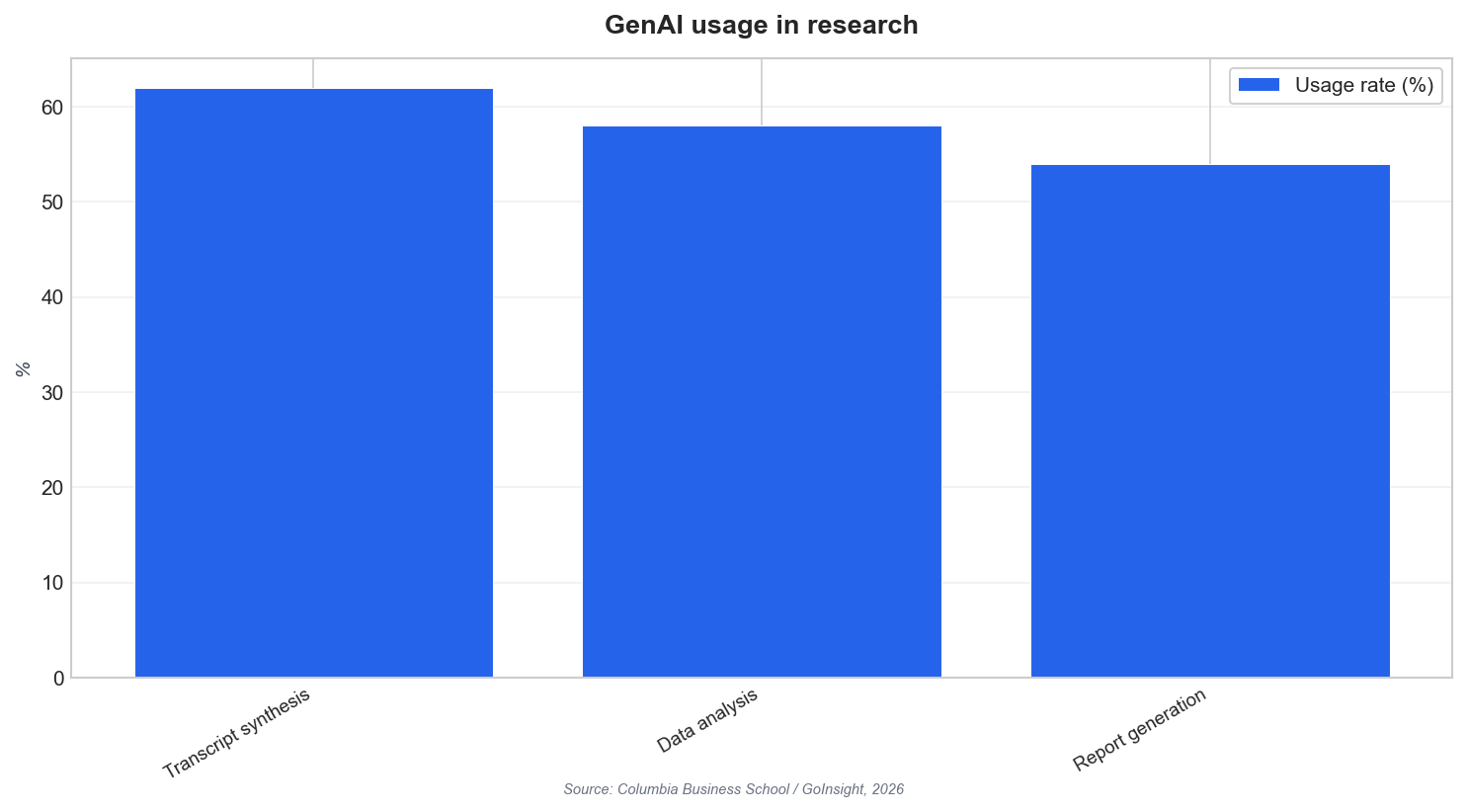
Embedding usually starts with the highest-friction steps. A Columbia Business School study cited by GoInsight reports that, among active users, 62% apply GenAI for transcript synthesis, 58% for data analysis, and 54% for report generation. The same source frames the impact as a role shift: researchers are not necessarily being replaced, but moving from data processors to insight curators as foundational tasks become automated. For Singapore teams, this maps cleanly to common bottlenecks in qualitative work, where transcript review and consistent coding often slow delivery and make scaling difficult across multiple studies.
Where GenAI Fits in the Modern Insight Stack
Several sources describe GenAI as an “intelligent layer” that sits on top of the analytics stack. Mu Sigma says this layer helps teams query data, interpret results, and generate insights through natural language, reducing dependency on manual SQL, static dashboards, and analyst-only workflows. It also describes GenAI generating end-to-end execution pipelines, such as SQL, Python ETL scripts, or dbt models, while embedding continuous data quality monitoring to detect issues like null values or schema drift. In practice, this supports a research workflow where insight questions can be explored faster, and outputs can be refreshed as new data arrives.
Once synthesis and analysis are moving faster, teams also expand the scope of what they measure. Meltwater argues that generative AI tools are becoming a lens for understanding how consumers discover, evaluate, and trust brands, because AI assistants can act as entry and exit points for information. This introduces AEO (Answer Engine Optimization) and GEO (Generative Engine Optimization) as research-relevant concepts: not only what consumers ask, but how AI interprets and represents a brand in generated answers. For Singapore insight teams, this can add a new research track alongside classic awareness and consideration metrics.
Adoption signals in the sources suggest why teams are building now. LeewayHertz cites a Gartner forecast that by 2026, more than 80% of organizations will have incorporated generative AI applications into their operations. GoInsight adds that a CBS study found 30% of respondents had already used GenAI to guide decisions previously made without empirical analysis, while 81% use or plan to use it for market listening and competitor tracking. Put together, these figures point to a workflow shift: GenAI becomes the connective tissue across listening, synthesis, analysis, and reporting, with governance and data quality determining how far it scales.
How are Singapore insight teams using GenAI in the research workflow?
Which research tasks are most commonly automated with GenAI?
Why do GEO and AEO matter for market research?
What is the adoption outlook for generative AI in organizations?
How does GenAI reduce reliance on manual analytics work?