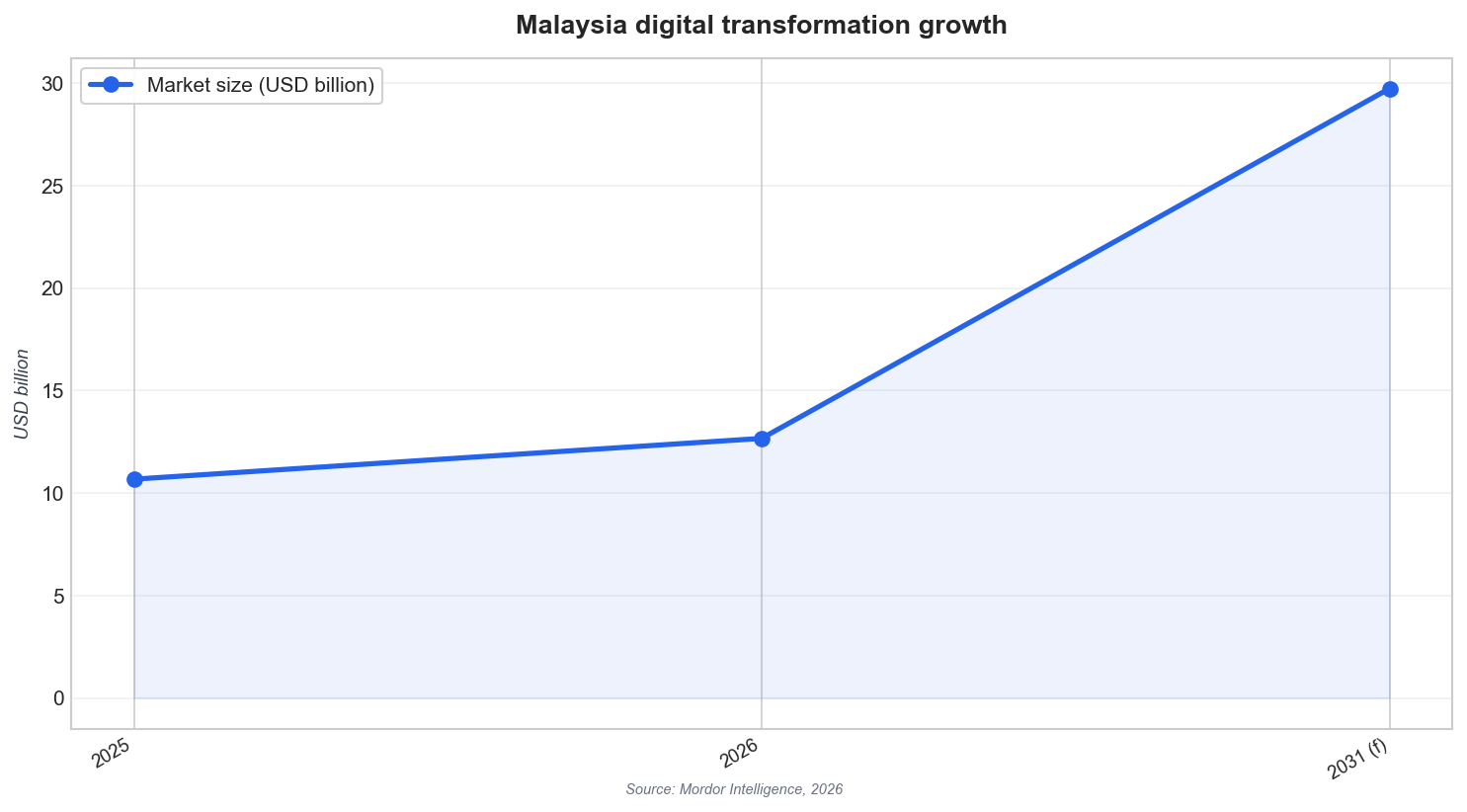
In 2026, customer insight teams in Malaysian banks and telcos are modernising their approaches because the business context is moving quickly. Malaysia’s digital transformation market is valued at USD 12.67 billion in 2026, up from USD 10.68 billion in 2025, with a forecast of USD 29.74 billion by 2031 and a CAGR of 18.62% for 2026-2031 (Mordor Intelligence, January 2026). At the same time, Fitch Solutions revised Malaysia’s 2026 real GDP growth forecast to 4.3% (from 4.1%), while exports growth picked up from 10.9% in Q4 2025 to 12.7% in Q1 2026 and retail sales growth rose from 6.2% in January 2026 to 7.7% in February (Fitch Solutions, May 2026). That combination makes faster, better-governed customer evidence more valuable, especially for high-volume service organisations.
A core change is the way CX research is being paired with automation data from day-to-day customer service. Globally, the AI customer service market is projected to reach USD 15.12 billion in 2026 (Bayelsawatch citing Polaris Market Research, April 2026). The same source states that by 2026, 80% of routine customer interactions will be handled completely by AI, and that Gartner estimates up to USD 80 billion in contact center labor cost savings by the end of 2026 due to AI adoption. For Malaysian banks and telcos, this is not a Malaysia-specific forecast, but it is a practical reference point: as AI handles more routine contacts, CX teams can mine richer operational signals (like repeat-contact drivers and escalation patterns) and feed them back into experience research programs to prioritise what needs human-led discovery.
From Surveys to Orchestration: Platforms, Partnerships, and Governance
Modern CX work is also becoming more platform-led, with stronger links between research insight and operational execution. Grand View Research values the global customer experience management (CEM) market at USD 15.5 billion in 2025 and projects growth from USD 17.7 billion in 2026 to USD 47.7 billion by 2033, at a CAGR of 15.2% from 2026 to 2033. The same report notes that cloud-based CEM reduces heavy infrastructure investments, while on-premises deployments are expected to grow at a significant CAGR because regulated industries require strict controls over customer data, auditability, and data residency. That matters in Malaysian banking and telecom environments where governance and compliance expectations are high, pushing teams to design research operations that can withstand audit and still move quickly.
Partnership ecosystems are accelerating how insight turns into action. Grand View Research highlights that in January 2026, Medallia and Ada formed a strategic partnership to combine Ada’s real-time, AI-powered capabilities with Medallia’s omnichannel customer experience and operational intelligence, with the goal of turning insights into automated actions and managing complex workflows more effectively. While this partnership is global, it signals what modernised CX looks like in practice: feedback, analytics, and automation loops that close faster than traditional research cycles. Bayelsawatch also reports that around 47% of companies say their positive view of customer experience stems from being able to clearly track how CX investments impact revenue, and that companies see an average return of USD 3.50 for every USD 1 invested in AI customer services. For CX leaders, that reinforces the value of designing research that can be connected to measurable outcomes.
Finally, capability building depends on the wider research supplier landscape and the data discipline that sits behind it. The Business Research Company lists many major companies operating in the global marketing research and analysis services market, including Ipsos, GFK, Mintel, Forrester, Kantar, Gartner, Dynata, and others, alongside Malaysia-based firms such as Dynamic Search Sdn. Bhd. and Cardas Research & Consulting Sdn Bhd (The Business Research Company, April 2026). For customer experience research in Malaysia, that mix supports hybrid models: internal CX analytics teams can partner with external specialists for deep dives, while keeping governance tight and integrating findings into CEM workflows. The result is a more modern research operation that is designed for 2026 realities: faster cycles, stronger controls, and clearer paths from insight to service change.
What is driving the modernisation of customer experience research in Malaysia in 2026?
How is AI changing CX research workflows for banks and telcos?
Why do regulated industries still consider on-premises CX platforms?
What market signals show CX platforms are growing globally?
Which types of partners support CX research programmes in Malaysia?