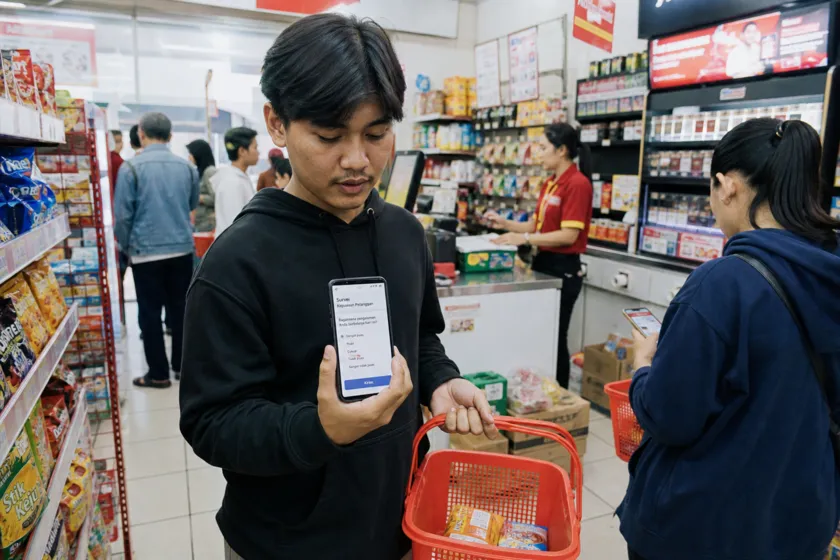
Indonesia’s digital economy runs through the phone. Business reporting highlights high smartphone penetration, affordable data, and a young, digitally fluent population driving growth across e-commerce, fintech, healthtech, edtech, and logistics platforms. Internet penetration is reported at approximately 75–78%, with over 210 million users, and smartphone adoption continuing to rise. For researchers and CX teams, that combination changes how you should design questionnaires: every screen must be easy to read, every tap must feel worth it, and every question must assume fast context-switching inside a mobile day.
Network conditions also shape the right mobile-first pattern. GlobalData notes Indonesia’s consumers are shifting from traditional voice services toward data consumption, while 4G remains the leading mobile technology across the forecast period. Telkomsel is cited as having 97% 4G population coverage and, as of mid-2025, 3,000 5G base stations across 56 cities. In Batam, Telkomsel’s 5G expansion is described as bringing active base stations to about 112 in that area. Mobile surveys should therefore load quickly on 4G and remain resilient when users move between coverage zones or device conditions.
Mobile Survey Design Choices That Fit Indonesia’s Consumer Reality
Survey content should reflect how Indonesian consumers shop and decide. Roland Berger’s Asia Consumer Study 2026 reports that 33% of Indonesians are “Tradition Keepers,” with spending peaks during events like Eid and Lunar New Year. It also reports a rapid shift in brand preference: preference for domestic brands fell from 57% in 2024 to 33% in 2025, while openness to new brands increased from 35% to 45%. For mobile-first surveys, that means timing matters and segmentation matters. Build short, event-aware pulses around major moments, and include brand-discovery questions that can separate tradition-driven buyers from trend-driven switchers.
Use mobile-native question formats that match what people already do on their phones. In Indonesia’s crypto market, the Indonesia Crypto & Web3 Report 2025 states there are more than 19 million active crypto users, and that 58.2% hold crypto as a long-term investment versus 20.2% who primarily do short-term trading. Those figures underline a practical design point: many respondents can handle detailed choices on a phone when the topic feels relevant, but they still need clarity and tight wording. Keep scales consistent, avoid dense grids, and use progressive disclosure so complexity only appears when it is earned by prior answers.
Finally, plan for device diversity and fast-changing usage contexts. Omdia’s Southeast Asia vendor data shows how mixed the Android ecosystem can be, with vendors shipping millions of units across the region, while also noting that TRANSSION’s competitively priced Infinix and TECNO models support strong positions in Indonesia and the Philippines. Combine that with Indonesia’s geography of over 17,000 islands, where connectivity is described as a necessity for integration, and you get a clear mandate for mobile survey best practices Indonesia teams can trust: optimize for low friction, keep payloads light, and test across a range of screen sizes so the survey experience stays readable, tappable, and stable.
What’s driving the need for mobile-first surveys in Indonesia?
How should survey designers account for Indonesia’s network landscape?
Which consumer shifts should surveys measure right now?
How can mobile-first surveys reflect major spending moments?
What do mobile survey best practices in Indonesia emphasize for device diversity?