
Client
Issues
Consumer goods companies across Southeast Asia faced increasing complexity in managing fragmented markets with heterogeneous consumer preferences. Traditional distribution models struggled to keep pace with modern trade expansion, e-commerce growth, and last-mile delivery requirements. Margin pressure intensified due to rising input costs, promotional intensity, and inefficient inventory management. Demand forecasting accuracy was often low, leading to stockouts in high-growth areas and excess inventory in slower-moving markets. Limited consumer insight integration constrained product innovation and portfolio optimization. In addition, inconsistent pricing strategies and channel conflicts reduced overall market effectiveness and brand consistency across the region.
Solution
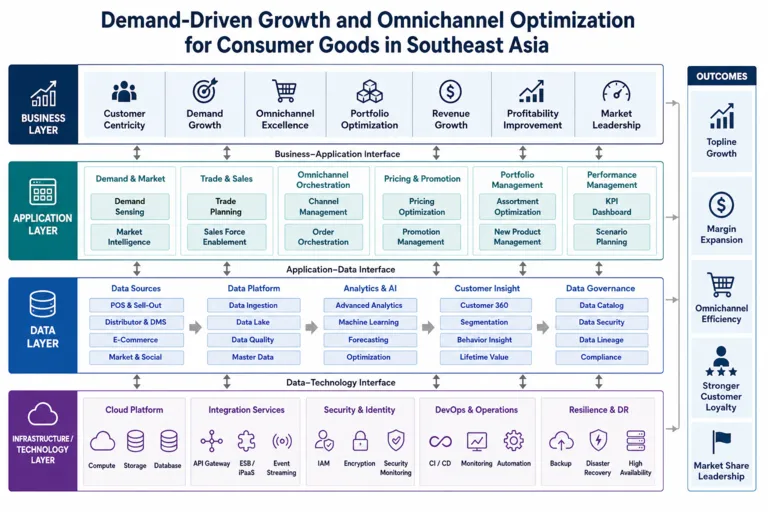
Eurogroup Consulting developed a comprehensive consumer goods growth framework focused on demand-driven planning, portfolio optimization, and channel strategy alignment. The solution integrated consumer insights, advanced forecasting models, and route-to-market optimization to improve commercial performance. Product portfolios were re-segmented based on consumption occasions, price sensitivity, and channel dynamics. Distribution strategies were redesigned to balance traditional trade, modern retail, and digital channels. Advanced analytics tools were embedded to improve demand forecasting, promotional effectiveness, and inventory planning. The framework emphasized scalable execution, enabling consistent performance improvement while allowing for local market customization.
Approach
The engagement began with a detailed assessment of consumer demand patterns, retail channel structures, and competitive intensity across priority Southeast Asian markets. Eurogroup Consulting conducted consumer surveys, retail audits, and distributor performance diagnostics. SKU-level sales data and promotion effectiveness were analyzed to identify profitability drivers and leakage points. Channel economics were modeled to assess margin performance across traditional trade, modern retail, and e-commerce. Cross-functional workshops aligned commercial, supply chain, and marketing teams around growth priorities. Pilot initiatives tested revised assortment strategies, pricing tiers, and channel incentives before broader regional rollout.
Recommendations
Eurogroup Consulting recommended simplifying and rationalizing product portfolios to focus on high-velocity and high-margin SKUs. Strengthening omnichannel distribution strategies was prioritized to ensure consistent availability and pricing across retail formats. The firm advised deploying advanced demand forecasting and inventory optimization tools to reduce working capital requirements. Pricing and promotion governance frameworks were recommended to improve margin discipline. Investments in consumer insight capabilities were also proposed to support faster innovation cycles and better alignment with evolving preferences. Capability-building initiatives were recommended to ensure sustainable execution across markets.
Engagement ROI
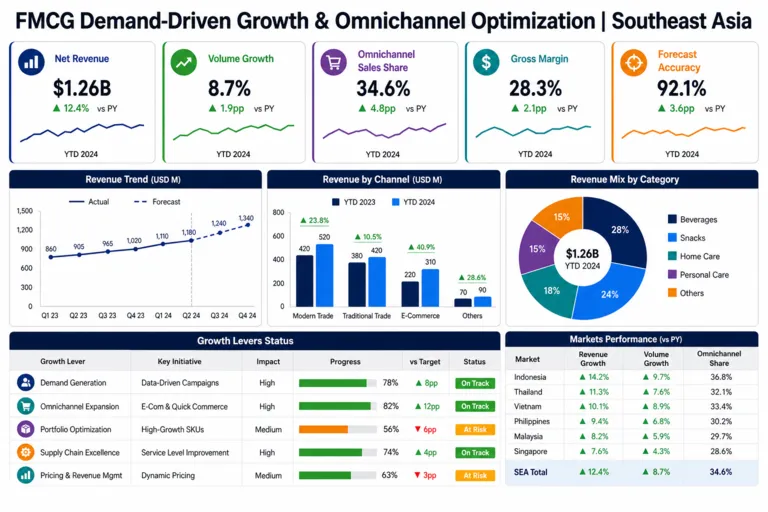
The engagement delivered measurable commercial and operational improvements. Demand forecasting accuracy improved by 15–25%, reducing stockouts and excess inventory. Inventory holding costs declined by 10–18%, releasing working capital. Portfolio rationalization increased average SKU profitability by 8–12%. Improved channel strategies supported revenue growth of 5–10% in pilot markets without proportional increases in selling costs. Promotional efficiency gains improved gross margins by 2–4 percentage points. Overall, the initiative strengthened market responsiveness, protected profitability, and enhanced long-term growth sustainability across Southeast Asia.