
Client
Issues
Transport and mobility systems across Southeast Asia faced mounting pressure from rapid urbanization and increasing travel demand. Road congestion resulted in significant productivity losses, with average commute times in major cities often exceeding 60–90 minutes per trip. Public transport networks struggled to keep pace with population growth, leading to overcrowding and service reliability issues. Fragmented planning and limited coordination between transport agencies reduced system efficiency. High reliance on private vehicles contributed to rising emissions and fuel consumption. Funding constraints, regulatory complexity, and uneven institutional capacity further limited the ability to implement integrated, long-term mobility solutions across cities and countries.
Solution
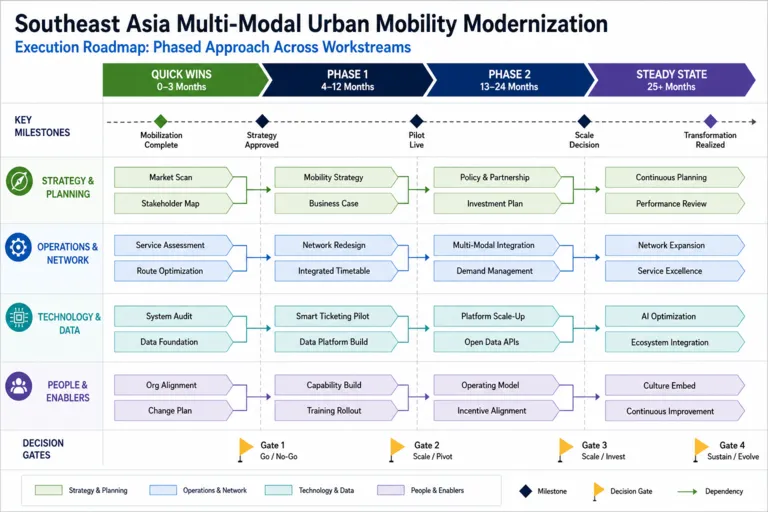
Eurogroup Consulting developed a comprehensive, multi-modal transport and mobility strategy designed to improve efficiency, accessibility, and sustainability across Southeast Asia. The solution emphasized expanding mass transit systems, improving first- and last-mile connectivity, and integrating emerging mobility solutions such as electric buses and shared transport services. Smart mobility tools—including integrated ticketing systems, data-driven traffic management, and performance analytics—were embedded to enhance system coordination and user experience. Sustainability objectives were incorporated through emissions reduction targets, energy-efficient fleet strategies, and alignment with urban development plans.
Approach
The engagement began with an in-depth assessment of urban mobility patterns, transport infrastructure capacity, and commuter behavior across major Southeast Asian cities. Eurogroup Consulting analyzed travel demand data, modal split trends, and congestion hotspots to identify priority intervention areas. Institutional and regulatory frameworks were reviewed to assess governance and funding constraints. Stakeholder engagement sessions were conducted with transport authorities, operators, urban planners, and private sector partners to align objectives. Scenario modeling evaluated the impact of alternative investment and policy options. Pilot programs were implemented to test integrated ticketing, electric mobility deployment, and traffic optimization measures, with performance outcomes informing broader rollout plans.
Recommendations
Eurogroup Consulting recommended accelerating investment in mass transit infrastructure, particularly high-capacity rail and bus rapid transit systems, to shift demand away from private vehicles. Improving first- and last-mile connectivity through feeder services and non-motorized transport infrastructure was prioritized. The firm advised adopting electric and low-emission fleets to reduce environmental impact and operating costs. Institutional reforms were recommended to strengthen coordination between transport agencies and integrate land-use and mobility planning. Data-driven performance management systems were also proposed to support continuous optimization of transport services.
Engagement ROI
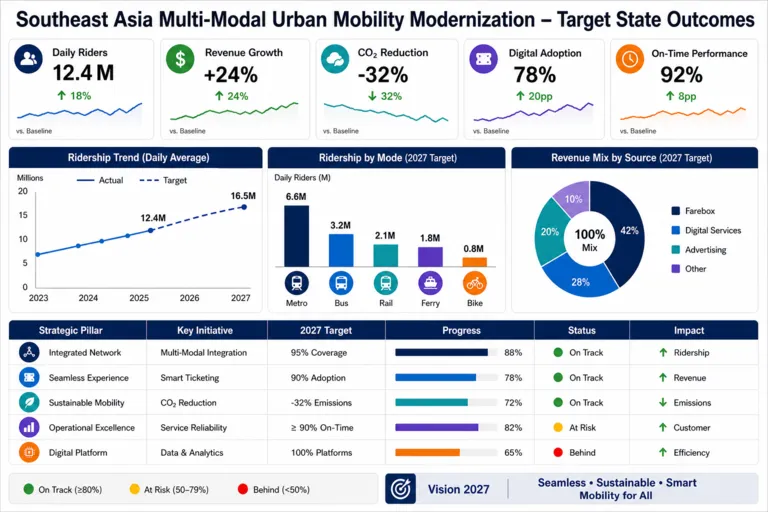
The transport and mobility initiative delivered tangible system-level benefits across pilot cities. Average commute times were reduced by 10–18%, improving productivity and quality of life. Public transport ridership increased by 15–30% following service improvements and integrated ticketing deployment. Fleet electrification initiatives reduced transport-related emissions by 8–15% and lowered operating costs by approximately 10% over conventional fleets. Traffic management improvements improved average travel speeds by 12–20% on key corridors. Overall, the engagement enhanced urban mobility efficiency, supported sustainability objectives, and established a scalable foundation for long-term transport system modernization across Southeast Asia.