
Client
Issues
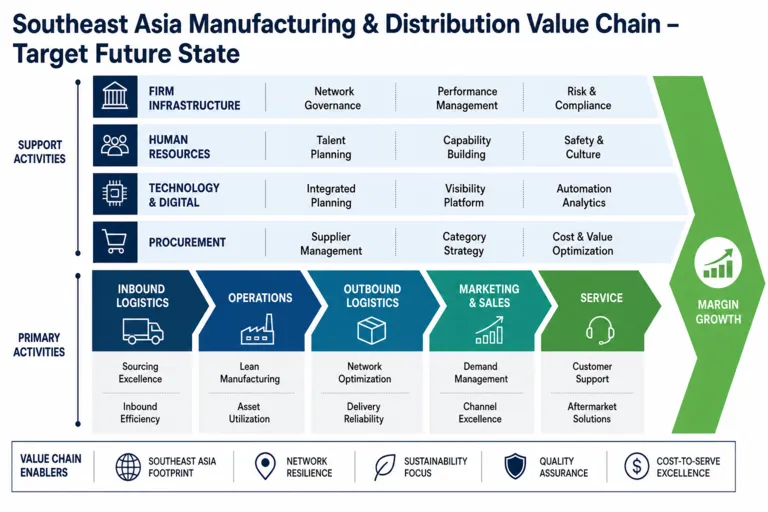
Value chains across Southeast Asia were characterized by fragmentation, limited transparency, and suboptimal coordination between upstream and downstream activities. Supplier bases were often highly dispersed, increasing procurement complexity and cost volatility. Manufacturing footprints were not always aligned with demand patterns, resulting in excess capacity in some locations and bottlenecks in others. Logistics and distribution inefficiencies compounded these issues, increasing lead times and working capital requirements. Limited data integration across value chain stages constrained performance monitoring and decision-making. Exposure to supply disruptions, geopolitical risks, and regulatory changes further highlighted the lack of resilience embedded in existing value chain structures.
Solution
Eurogroup Consulting developed a comprehensive value chain optimization framework focused on efficiency, resilience, and cost transparency. The solution integrated end-to-end value chain mapping, cost-to-serve analysis, and performance benchmarking across sourcing, production, and distribution activities. Structural improvements included supplier rationalization strategies, manufacturing footprint optimization, and logistics network redesign. Digital enablers were incorporated to improve visibility across value chain stages, supporting real-time performance monitoring and scenario analysis. The framework emphasized cross-functional coordination and governance to ensure sustainable execution across multiple countries and operating units.
Approach
The engagement began with detailed end-to-end value chain mapping across priority product categories and markets. Eurogroup Consulting conducted cost breakdown analyses to identify margin leakage and inefficiencies at each stage. Supplier performance, manufacturing utilization, and logistics service levels were benchmarked against regional and global peers. Scenario modeling evaluated alternative sourcing strategies, production locations, and distribution configurations under different demand and risk assumptions. Cross-functional workshops aligned procurement, operations, supply chain, and commercial teams around improvement priorities. Pilot initiatives were implemented to validate optimization levers before regional scaling.
Recommendations
Eurogroup Consulting recommended rationalizing supplier portfolios to improve scale leverage and reduce complexity. Manufacturing footprint optimization was advised to better align capacity with demand growth and cost structures. Logistics network redesign initiatives were recommended to reduce lead times and improve service reliability. The firm advised strengthening data integration across value chain stages to support continuous performance monitoring. Governance enhancements were proposed to improve cross-functional coordination and accountability. Risk management mechanisms, including dual sourcing and buffer strategies, were recommended to enhance resilience against disruptions.
Engagement ROI
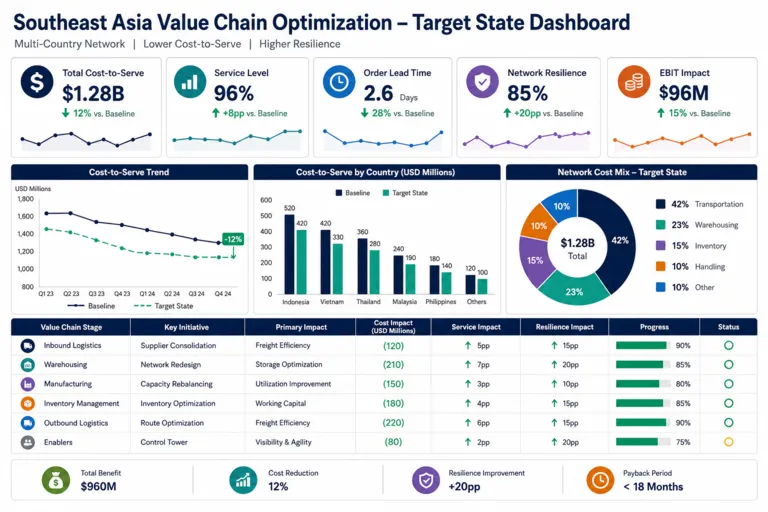
The value chain optimization initiative delivered significant operational and financial benefits. End-to-end cost reductions of 8–15% were achieved through supplier consolidation, footprint optimization, and logistics improvements. Lead times were reduced by 12–20%, improving service levels and responsiveness. Inventory levels declined by 10–18%, releasing working capital. Improved capacity utilization increased manufacturing efficiency by 8–12%. Enhanced resilience measures reduced disruption-related losses by an estimated 15–25%. Overall, the engagement strengthened competitiveness, profitability, and long-term value chain sustainability across Southeast Asia.