
Client
Issues
Healthcare systems across Southeast Asia faced uneven access to services, with significant disparities between urban centers and secondary or rural regions. Hospital capacity constraints resulted in overcrowding, long waiting times, and suboptimal patient outcomes. Workforce shortages, particularly among specialized medical professionals, limited service expansion. Fragmented care delivery models and limited data integration reduced care coordination and operational efficiency. Capital investment planning was often misaligned with demand growth, leading to underutilized assets in some areas and critical shortages in others. In addition, inconsistent regulatory frameworks complicated private sector participation and cross-border healthcare investments.
Solution
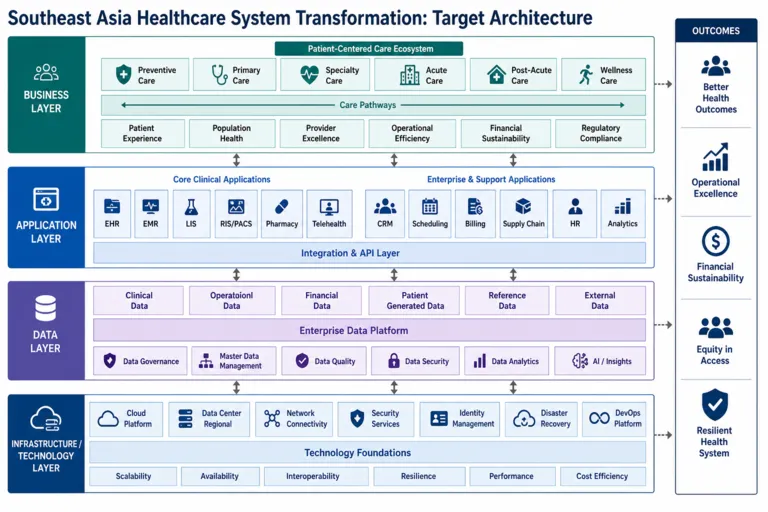
Eurogroup Consulting developed a healthcare system transformation framework focused on capacity optimization, service integration, and digital enablement. The solution emphasized strengthening primary care networks to reduce unnecessary hospital demand, expanding diagnostic and outpatient services, and improving referral pathways. Digital health solutions, including electronic medical records and telemedicine platforms, were integrated to enhance continuity of care and data-driven decision-making. Workforce planning tools were introduced to align staffing levels with service demand. The framework also incorporated financial sustainability levers, supporting more efficient capital allocation and improved cost control across healthcare facilities.
Approach
The engagement began with a comprehensive assessment of healthcare infrastructure, service utilization, and patient flows across multiple Southeast Asian markets. Eurogroup Consulting analyzed hospital bed density, workforce ratios, and utilization rates relative to demographic and epidemiological trends. Regulatory reviews and reimbursement mechanisms were evaluated to identify barriers to system efficiency. Stakeholder workshops with healthcare providers, policymakers, and payers were conducted to align priorities and identify feasible reform pathways. Pilot initiatives were implemented to test care pathway redesign and digital solutions, with performance metrics tracked to inform scaling decisions across the region.
Recommendations
Eurogroup Consulting recommended rebalancing healthcare delivery toward preventive and primary care services to reduce pressure on acute care facilities. Investment in digital health platforms was prioritized to improve patient management, data interoperability, and clinical decision support. Workforce development programs were proposed to address skill gaps and improve staff productivity. The firm advised implementing demand-based capacity planning models to guide infrastructure investment decisions. Strengthening public-private collaboration frameworks was also recommended to mobilize private capital while maintaining service affordability and quality standards.
Engagement ROI
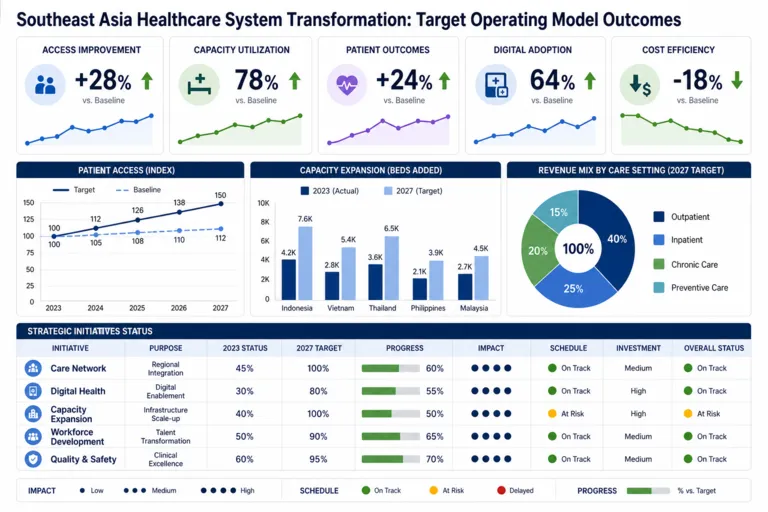
The healthcare transformation initiative delivered measurable system-level improvements. Pilot regions experienced reductions in average hospital length of stay by 10–18%, freeing capacity for higher-acuity cases. Improved referral management reduced unnecessary emergency visits by approximately 12–20%. Digital health adoption increased outpatient throughput by 15–25% without proportional staffing increases. Capital planning improvements supported better asset utilization, reducing idle capacity by an estimated 10%. Overall, the engagement improved patient access, enhanced care quality, and strengthened the financial sustainability of healthcare systems across Southeast Asia.