
Client
Issues
Strategic planning processes across Southeast Asia were often challenged by limited forward-looking analysis and insufficient linkage between strategy formulation and execution. Many organizations relied on static planning cycles that failed to account for macroeconomic volatility, regulatory shifts, and competitive disruption. Scenario planning was underutilized, reducing preparedness for downside risks and missed opportunities. Fragmented market intelligence and inconsistent performance data across countries constrained effective prioritization. In addition, weak governance mechanisms reduced accountability for strategy execution, leading to delays, resource misallocation, and erosion of strategic focus. These issues collectively limited the ability of organizations to respond effectively to fast-changing market conditions.
Solution
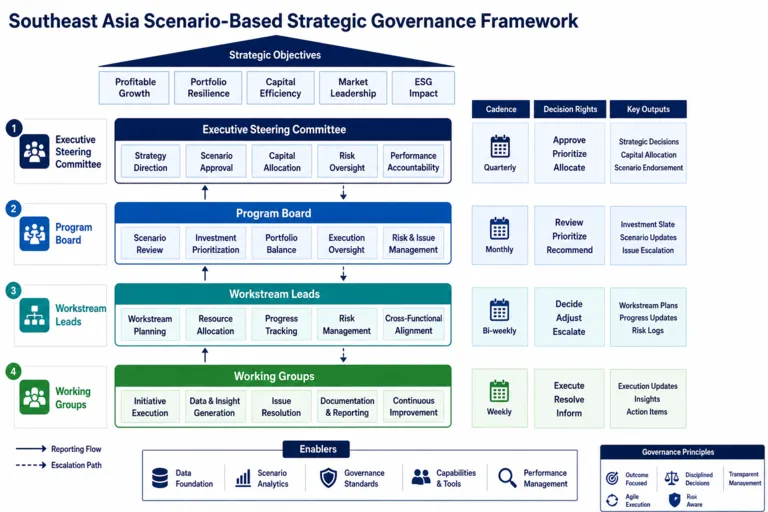
Eurogroup Consulting developed a scenario-based strategic planning framework designed to enhance flexibility, clarity, and execution discipline across Southeast Asia. The solution integrated macroeconomic outlooks, sector-specific growth drivers, and internal capability assessments into a coherent strategic architecture. Multiple strategic scenarios were developed to reflect potential market developments, regulatory changes, and competitive responses. Each scenario was translated into clear strategic choices, investment priorities, and risk mitigation actions. The framework emphasized alignment between strategy and execution by linking strategic objectives to measurable KPIs, governance structures, and capital allocation processes. The approach enabled organizations to adapt strategies dynamically while maintaining long-term direction.
Approach
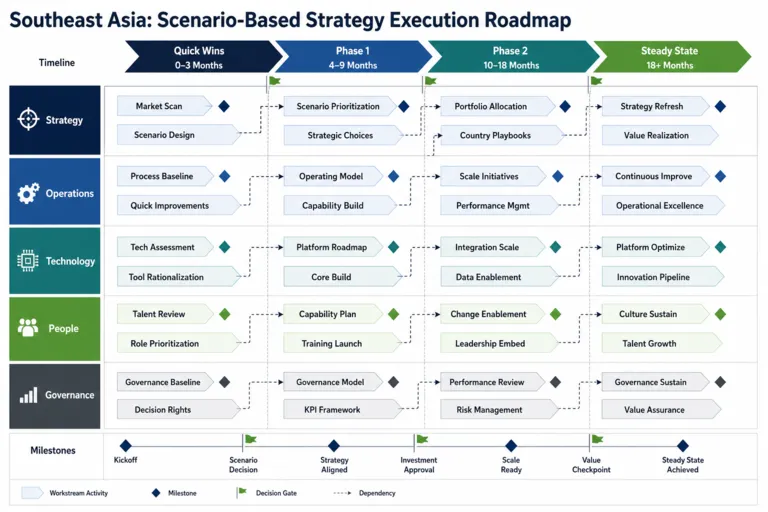
The engagement began with a comprehensive diagnostic of existing strategic planning processes, governance structures, and decision-making frameworks. Eurogroup Consulting conducted macroeconomic and sector analyses across key Southeast Asian markets, incorporating country-level growth forecasts, regulatory trends, and competitive dynamics. Internal assessments evaluated organizational capabilities, financial constraints, and execution readiness. Facilitated leadership workshops were used to define strategic ambition, test assumptions, and develop alternative scenarios. Quantitative modeling supported evaluation of strategic options under different market conditions. The final strategy was translated into an execution roadmap with clear milestones, ownership structures, and performance monitoring mechanisms.
Recommendations
Eurogroup Consulting recommended embedding scenario-based planning into annual and multi-year strategy cycles to improve resilience and adaptability. Strengthening strategy governance through clearly defined decision rights, accountability structures, and performance reviews was prioritized. The firm advised aligning capital allocation processes with strategic priorities to improve investment discipline. Enhancing market intelligence capabilities was recommended to support continuous strategy refinement. Leadership alignment and communication initiatives were proposed to ensure consistent understanding and execution across business units and countries. Finally, periodic strategy refresh cycles were recommended to reflect evolving market and regulatory conditions.
Engagement ROI
The strategic planning initiative delivered measurable improvements in decision quality and execution effectiveness. Capital allocation efficiency improved by approximately 10–15%, driven by clearer investment prioritization and reduced spending on low-impact initiatives. Strategy execution timelines shortened by 20–25%, reflecting improved governance and accountability. Organizations reported improved alignment across regional and country teams, reducing duplicated initiatives by an estimated 15–20%. Scenario planning enhanced preparedness for market volatility, supporting faster response times to regulatory or economic shifts. Overall, the engagement strengthened strategic resilience, improved execution discipline, and enhanced long-term growth sustainability across Southeast Asia.