
Client
Issues
Supply chain and logistics systems across Southeast Asia faced structural and operational inefficiencies that constrained regional competitiveness. Port congestion, limited multimodal connectivity, and uneven infrastructure quality created bottlenecks along key trade corridors. Logistics costs remained high relative to global benchmarks, often exceeding 20–25% of product value in certain sectors due to inefficient routing, fragmented warehousing networks, and limited coordination between transport modes. Cross-border trade processes were slowed by inconsistent customs procedures and regulatory requirements, increasing lead times and uncertainty. Limited digitalization reduced end-to-end visibility, complicating demand forecasting, inventory planning, and disruption management. These challenges were amplified by rising fuel costs, labor constraints, and exposure to supply chain shocks.
Solution
Eurogroup Consulting developed an integrated supply chain and logistics optimization framework designed to improve efficiency, resilience, and scalability across Southeast Asia. The solution focused on aligning infrastructure investment, network design, and digital enablement to support seamless regional trade flows. Key elements included the redesign of logistics networks to optimize hub-and-spoke configurations, consolidation of warehousing footprints, and improved multimodal integration across ports, roads, rail, and inland terminals. Digital solutions were embedded to enhance shipment tracking, performance monitoring, and demand forecasting. The framework also incorporated regulatory alignment principles and public–private coordination mechanisms to reduce friction at border crossings and logistics nodes.
Approach
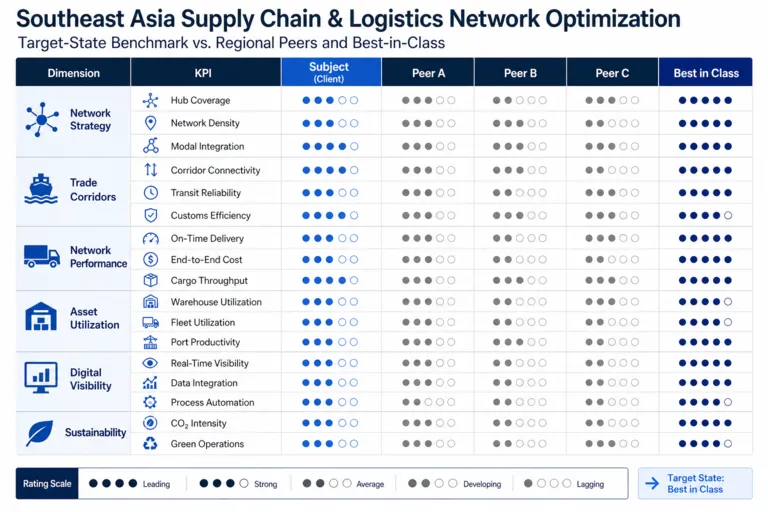
The engagement began with a comprehensive mapping of regional trade flows, logistics corridors, and distribution networks across priority Southeast Asian markets. Eurogroup Consulting benchmarked logistics performance indicators—including transit times, costs, and reliability—against regional and global peers. Detailed diagnostics were conducted on port capacity, inland transport infrastructure, warehousing utilization, and last-mile delivery capabilities. Stakeholder interviews were held with logistics providers, shippers, port authorities, and regulators to identify operational bottlenecks and coordination gaps. Scenario modeling was used to evaluate alternative network configurations and investment priorities. Pilot initiatives were launched to test digital visibility tools and corridor optimization measures, with performance data used to refine the regional rollout strategy.
Recommendations
Eurogroup Consulting recommended prioritizing investment in strategic logistics hubs and multimodal corridors to reduce congestion and improve network resilience. The adoption of digital freight management platforms was advised to enhance real-time visibility, performance tracking, and coordination across supply chain partners. Regulatory harmonization efforts were recommended to streamline customs procedures and reduce cross-border delays. Network rationalization initiatives were proposed to consolidate warehousing footprints and optimize inventory placement. The firm also recommended strengthening public–private collaboration to accelerate infrastructure delivery and improve service standards, alongside capability-building programs to support advanced supply chain planning and risk management.
Engagement ROI
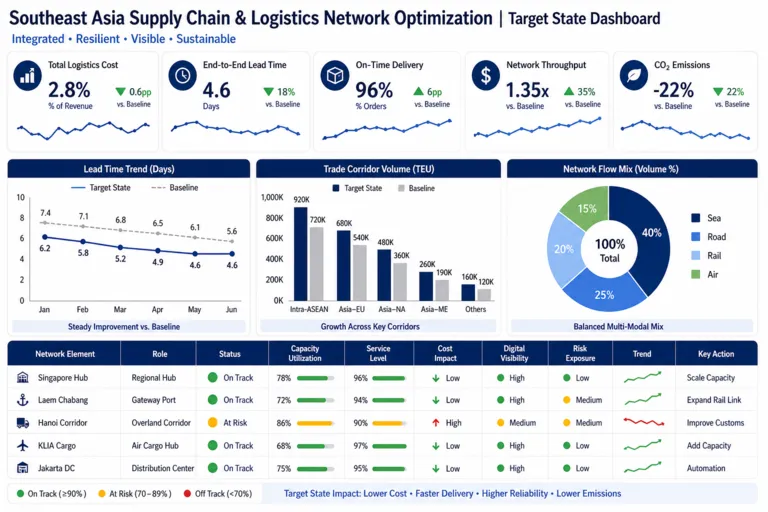
The engagement delivered measurable improvements in logistics performance across pilot corridors and networks. Average transit times were reduced by 12–22%, while end-to-end logistics costs declined by approximately 8–15% through network optimization and improved asset utilization. Digital visibility tools increased on-time delivery performance by 15–20% and reduced inventory holding costs by an estimated 8–12%. Streamlined cross-border processes shortened clearance times by 20–30% on selected routes. Overall, the framework strengthened supply chain resilience, improved service reliability, and enhanced Southeast Asia’s attractiveness as a competitive manufacturing and trade hub.