
Client
Issues
The construction sector across Southeast Asia faced a combination of structural, operational, and capability-related challenges. Project delivery timelines were frequently impacted by labor shortages, inconsistent contractor performance, and fragmented supply chains for construction materials. Cost overruns were common, driven by volatile input prices, weak cost control mechanisms, and limited visibility across project phases. Sustainability objectives were difficult to implement due to uneven adoption of green building standards and limited access to alternative construction materials. In addition, regulatory frameworks varied significantly across markets, complicating cross-border project execution and limiting scalability for regional contractors. The lack of standardized performance metrics and digital project management tools further constrained productivity improvements.
Solution
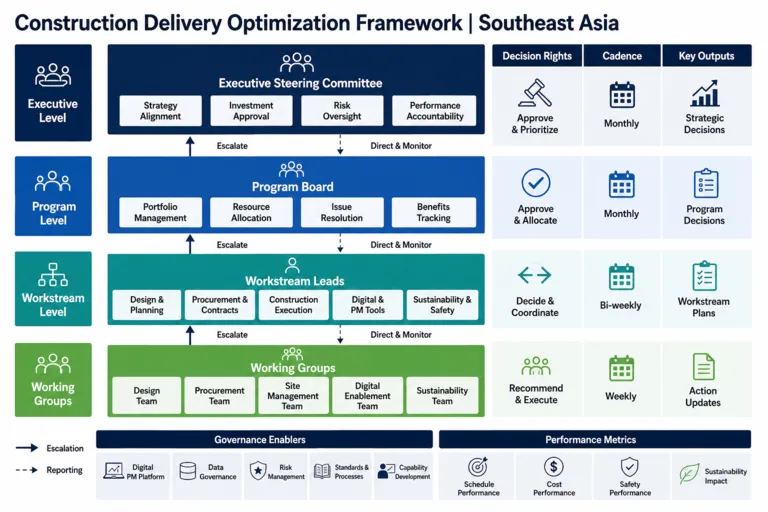
Eurogroup Consulting designed a comprehensive construction sector optimization framework focused on productivity enhancement, execution discipline, and sustainability integration. The solution combined strategic, operational, and capability-building levers to address both immediate execution gaps and long-term structural constraints. A standardized project governance model was introduced to improve cost control, timeline management, and quality assurance across large-scale developments. The framework promoted the adoption of modular construction techniques, digital project management platforms, and data-driven performance monitoring. Sustainability considerations were embedded through lifecycle cost analysis, energy-efficient design standards, and sourcing strategies for lower-impact materials. The solution was designed to be adaptable across markets while maintaining a consistent regional performance baseline.
Approach
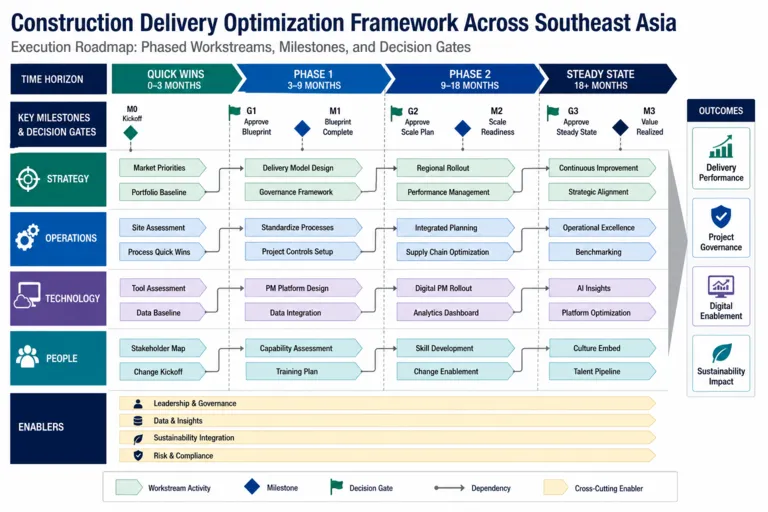
The engagement began with an in-depth diagnostic of construction ecosystems across priority Southeast Asian markets. Eurogroup Consulting conducted benchmarking of construction productivity, cost structures, and project outcomes against regional and international peers. Detailed assessments were performed across contractor capabilities, labor availability, material supply chains, and regulatory environments. Stakeholder interviews were conducted with developers, contractors, regulators, and financiers to identify execution bottlenecks and risk points. Based on these insights, pilot frameworks were tested on representative project types to validate scalability. Governance models, digital tools, and sustainability criteria were refined through iterative feedback before being consolidated into a region-wide construction performance playbook supported by implementation roadmaps.
Recommendations
Eurogroup Consulting recommended accelerating the adoption of standardized project governance frameworks to reduce execution variability and improve cost predictability. Investment in digital construction management platforms was prioritized to enhance real-time visibility across schedules, budgets, and quality metrics. The firm advised expanding modular and prefabricated construction methods to address labor shortages and shorten build timelines. Sustainability recommendations included mandatory energy-performance benchmarks, supplier sustainability screening, and lifecycle costing integration at the design stage. Capacity-building programs for contractors and project managers were also recommended to ensure consistent execution standards. Finally, the establishment of regional best-practice exchanges was proposed to support continuous improvement across ASEAN markets.
Engagement ROI
The engagement delivered measurable improvements in construction sector performance across participating markets. Pilot projects demonstrated average project duration reductions of 10–15%, while cost overruns were reduced by approximately 8–12% through improved governance and cost tracking. Adoption of modular construction methods lowered labor dependency by an estimated 20% on selected projects. Digital project management tools improved reporting accuracy and reduced administrative delays, contributing to faster decision-making cycles. Sustainability measures supported reductions in operational energy consumption of 15–25% for compliant buildings. Overall, the framework enhanced investor confidence, improved delivery reliability, and established a scalable foundation for long-term construction sector modernization across Southeast Asia.